A licence isn’t required to keep bees in the UK, but registration rules differ by nation. If you’re asking whether you need to register your beehive in the UK, BeeBase registration is required in England and Wales and available in Scotland. In Northern Ireland, the relevant programme is DAERA Bee Health.
It’s easy to focus on whether registration is compulsory and overlook why it can be useful. Registering an apiary helps the National Bee Unit notify beekeepers about nearby disease outbreaks, so you can stay informed about risks to your colony.
This guide explains the difference between a licence and registration, the information BeeBase asks for, and whether registration costs anything. It also covers the practical benefits and Northern Ireland’s separate arrangements, so you can identify what applies where you keep bees.
Key Takeaways
- You don’t need a licence to keep bees in the UK, but registration arrangements vary between nations.
- BeeBase registration is required in England and Wales, and open to beekeepers in Scotland.
- Find out what information BeeBase asks for, including colony numbers and contact details.
- Registering can help you receive alerts about disease outbreaks near your apiary.
- BeeBase registration is free; Northern Ireland has a separate DAERA Bee Health programme.
Do You Need a Licence to Keep Bees in the UK?
You don’t need a UK-wide licence to keep bees. However, you should still consider local rules, permission to use the land, bee movements and import conditions.
Permission to Keep Bees
Keeping bees does not require a licence in the UK, including Scotland. A licence and BeeBase registration are separate matters, and local arrangements can still affect where you place a hive. Before setting up, identify who controls the land and whether any site-specific conditions apply. If the apiary is on someone else’s land, agree the hive location with the owner first.
Local Rules for Beehives
Local councils may impose beekeeping rules, particularly in urban areas or near public spaces. Council requirements and landowner conditions can affect whether a particular site is suitable, even though there is no general UK beekeeping licence. Ask the relevant council about rules for your proposed location, then agree the placement with the landowner if needed. A garden beside a public space may raise different practical concerns from a secluded site.
National registration schemes also differ. In Scotland, you don’t need a licence to keep bees, and BeeBase registration is available. Northern Ireland has a separate DAERA Bee Health programme for beekeepers keeping Apis mellifera. These arrangements relate to registration and bee health, not a general licence to keep a hive.
Moving an established hive also needs planning. Bees moved more than 3 feet but less than 3 miles may return to their original location. A nearby site change can therefore disrupt the colony if bees keep flying back. Plan the new position before moving equipment, and factor in the bees’ familiarity with their surroundings. Relocating bees to a nearby site can take up to a month.
Importing honey bees involves specific requirements. Bees may be imported only from approved countries, and imports require a veterinary health certificate and inspection for disease on arrival. Register honey bee imports through the Import of Products, Animals, Food and Feed System, known as IPAFFS. Imports are limited to queen bees, except from New Zealand, where packages and colonies are permitted. Export conditions depend on the destination, so establish its requirements before arranging a shipment.
When setting up an apiary, choose equipment and bees to suit the site and your plans. The British National is the most common hive type in the UK, and a nucleus colony offers a smaller starting point than a full-sized colony. Consider access for inspections, especially in spring, and plan the hive position before the bees arrive. Buying locally sourced bees avoids the procedures involved in importing them.
What is BeeBase and do I have to register?
BeeBase is the National Bee Unit’s database for beekeepers, apiaries and colonies. Registration arrangements vary across the UK, and the information recorded can help you receive nearby disease alerts.
BeeBase Registration and Legal Requirements
BeeBase registration is required for beekeepers in England and Wales and is available to those in Scotland. Registration gives the National Bee Unit information about where colonies are kept. Northern Ireland uses a separate programme.
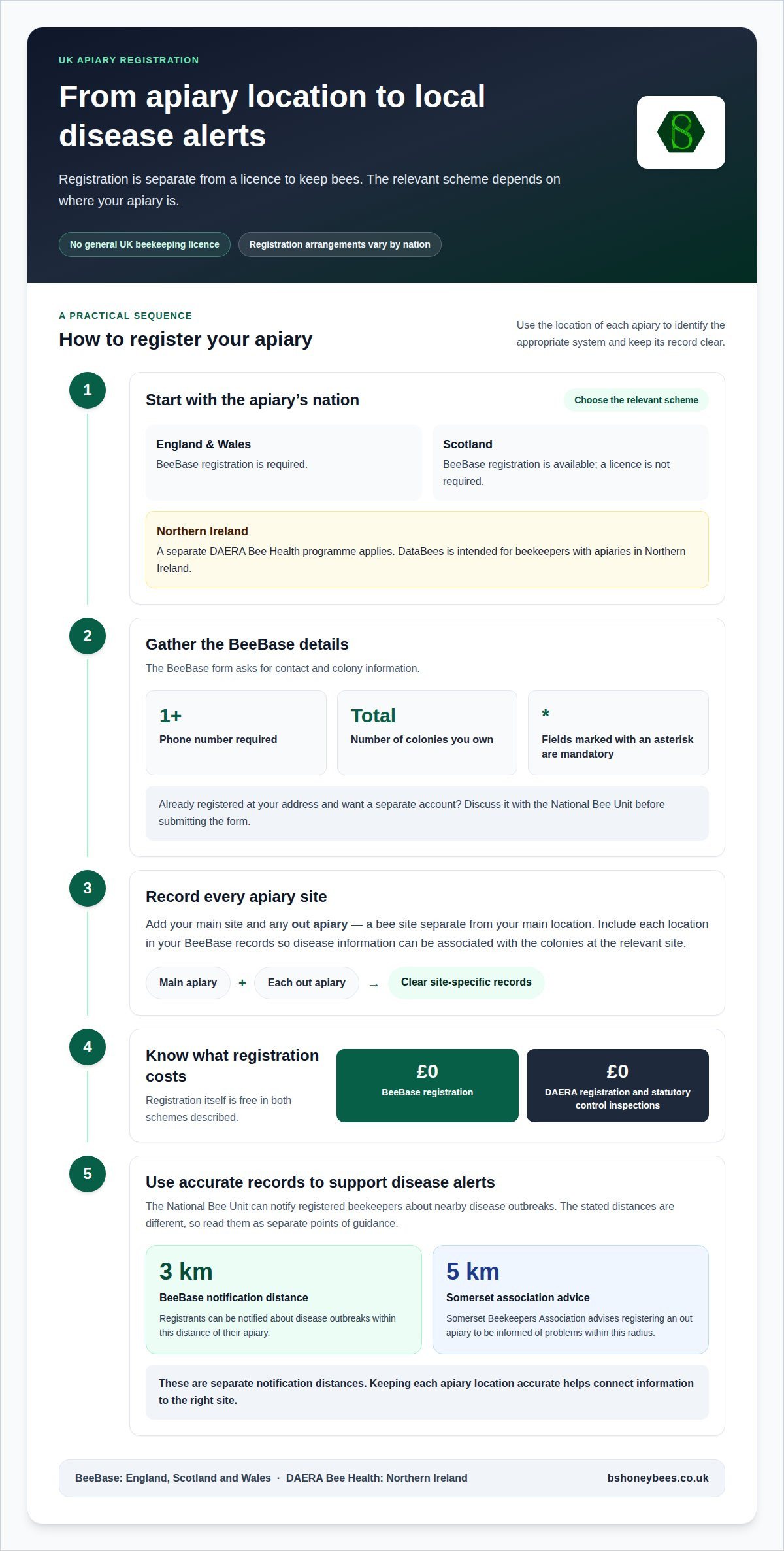
The form requires at least one phone number, and fields marked with an asterisk are mandatory. You must also provide the total number of colonies you own. If another beekeeper is already registered at your address and you want a separate account, discuss your registration with the National Bee Unit before submitting the form. Accurate details help distinguish your apiary and contact record.
Registering an Out Apiary
An out apiary is a bee site separate from your main location, so include it in your BeeBase records. Registering each site helps connect disease information to the colonies that could be affected, rather than relying on a single home address.
BeeBase registrants can be notified about disease outbreaks within 3 km of their apiary. The Somerset Beekeepers Association advises registering an out apiary so beekeepers can be informed of problems within a 5 km radius. These are separate notification distances, so include the relevant site details when recording an additional apiary.
BeeBase and DataBees
BeeBase is available in England, Scotland and Wales, while DataBees is intended for beekeepers with apiaries in Northern Ireland. The apiary’s location determines which registration system is relevant. This helps Northern Ireland beekeepers use the programme connected to their area.
DAERA’s Bee Health programme serves beekeepers keeping Apis mellifera in Northern Ireland. If you keep bees in different parts of the UK, record each apiary’s location clearly. This makes it easier to identify the appropriate scheme and the health information relevant to each site.
Registration Costs
BeeBase registration is free, with no charge for entering your beekeeper and apiary details. You can record an out apiary as well as your main site, helping the National Bee Unit associate alerts with the correct location.
In Northern Ireland, registration with the DAERA Bee Health programme and statutory control inspections are also free. Registration costs are separate from the cost of maintaining colonies or buying equipment. Keep your phone number, colony total and apiary locations accurate so the programme’s records remain useful for disease notifications.
Whether a UK beekeeping licence is required
No general licence is required to keep bees in the UK. For beginner beekeepers, the useful distinction is between permission to keep a colony and separate duties concerning registration, disease and medicines. A licence isn’t the only legal consideration: the country where your apiary sits affects which rules and notices apply.
Registration and licensing are separate matters. Registration and permission to keep bees are separate considerations. Scotland also has no beekeeping licence requirement. Northern Ireland has its own bee-health arrangements, so identify the relevant system for your apiary rather than assuming one UK-wide process covers every nation.
Health reporting is a key responsibility. In England, beekeepers must notify the National Bee Unit if they know or suspect their honey bee colonies have a notifiable disease or pest, under Article 3 of The Bee Diseases and Pests Control (England) Order 2006. The presence of Varroa destructor must also be reported in England under Article 3A. Suspecting a listed disease is therefore a reason to act, not to wait for routine inspections.
Veterinary medicine rules apply independently of licensing. Use only veterinary medicines authorised for honey bees and follow the label instructions. Keep records of medicines given to colonies for at least five years. In Scotland, beekeepers are required to keep records of medicines administered to their bees. These records help clarify treatment history when managing colonies across seasons.
Notices can also impose specific requirements. In England, beekeepers must comply with standstill notices issued under Article 6 of the 2006 Order. They must also follow destruction or treatment requirements specified in notices under Articles 7 and 8. These measures are distinct from a licence: they apply when a relevant notice is issued and can affect how colonies are moved or managed.
A hive doesn’t require a general beekeeping licence, but setting one up does require careful planning. Before bringing bees to a site, identify the apiary’s nation, understand its registration route and prepare to meet disease-reporting and medicine-record duties. These responsibilities continue through winter: keep treatment records and take appropriate action if disease is a concern.
Benefits of National Bee Unit registration
Registering with the National Bee Unit gives your apiary a place in a national beekeeper database. A practical benefit is disease-outbreak notification: BeeBase registrants are notified about outbreaks within 3 km of their apiary. That information can make local risks more visible while you manage colonies through the season.
Location matters. An alert linked to your apiary gives you a clearer reason to pay attention to nearby disease concerns than a general notice alone. For example, if an outbreak is reported within the notification area, stay alert during your next inspection and watch for signs that warrant further action. Registration doesn’t diagnose disease or replace good beekeeping practice, but it connects your site with relevant alerts.
Accurate records make alerts more useful. Keep your BeeBase details aligned with where your colonies are actually kept, especially if you add an out apiary or move a site. If your record shows an old location, notifications may not reflect the risks around your current colonies. Review your details after a move to keep the link between apiary and alert meaningful.
Keep contact preferences realistic: the National Bee Unit may not be able to use your preferred method every time. Provide reliable contact details and keep them current so important messages have a better chance of reaching you. Treat BeeBase notifications as one part of your approach, alongside regular inspections and your own observations of colony behaviour.
Registration also supports communication about laboratory results. Email notification replaces a paper copy, so provide an accessible email address to receive results electronically. Keep each message with your beekeeping records, then refer to it when considering the relevant colony’s health and management. This keeps results together with your notes throughout the season.
BeeBase doesn’t replace practical decisions about feeding, winter preparation or inspections. Those depend on what you observe in each colony. BeeBase connects beekeeper and apiary information with disease notifications and relevant communications. Use alerts to stay informed, assess your colonies carefully and keep clear records of what you observe.
For a beekeeper managing more than one apiary, registration can make location-specific information easier to interpret. A disease notification within 3 km relates to the registered apiary, not simply to a broad region. Keeping each site represented accurately helps you understand which colonies may be near an alert and organise your attention accordingly.
Is beehive registration free in the UK?
Yes. Registration with the National Bee Unit through BeeBase is free, so there’s no registration fee. Northern Ireland also has no fee for registration with the DAERA Bee Health programme or for statutory control inspections. The relevant system depends on where your apiary is located.
Free registration means joining the relevant bee-health database or programme. It doesn’t mean every part of keeping bees is free: hive equipment, colony care and other beekeeping expenses are separate. Keeping these costs distinct makes it easier to budget for an apiary without mistaking a free registration scheme for free beekeeping.
For beekeepers in England, Scotland or Wales, BeeBase is the National Bee Unit’s online database, and registration is free. The information you provide, including your contact number, colony total and apiary details, forms part of your beekeeping record. There’s no charge to enter these details.
Northern Ireland has a different arrangement. DAERA’s Bee Health programme is intended for beekeepers keeping Apis mellifera, and registration is free. Statutory control inspections also carry no fee there. This applies to those inspections, not every possible expense involved in managing an apiary or caring for colonies.
Keep the scope clear: registration records your beekeeper and apiary information; it doesn’t cover equipment, bees or veterinary medicines. For example, when adding a site, update the relevant apiary information as part of registration. Materials and colony management remain separate parts of beekeeping.
Free registration doesn’t remove the value of accurate details. BeeBase notifications relate to outbreaks within 3 km of a registered apiary, so a correct location helps make those messages relevant. Keep your phone number and colony information current as your apiary changes. A free record is most useful when its details reflect where your bees are kept.
A free database doesn’t replace other responsibilities. Disease reporting, medicine records and compliance with applicable notices remain separate duties. In England, for example, beekeepers must notify the National Bee Unit about known or suspected notifiable disease or pests. A free BeeBase registration doesn’t alter that reporting requirement.
Budget separately for your colonies’ practical needs and keep the relevant registration record accurate. This makes it clear which costs relate to registration and which are part of keeping bees.
BS Honey Bees: F1 Buckfast Queens
BS Honey Bees Ltd supplies F1 Buckfast Queens for beekeepers planning their next colony. After sorting registration and choosing an apiary, turn to bee and equipment choices that fit your setup. Options include Carniolan Queens and 5 / 6 Frame Nucs, whether you’re establishing a colony or considering a queen for an existing one.
For apiary equipment, BS Honey Bees Ltd also offers 2 in 1 Poly Nucs. Match your choice to your colony plans and the equipment you already use; registration itself doesn’t determine which bees or nucs suit your apiary.
Contact BS Honey Bees Ltd to discuss its queens and nucs.
Plan your next step with confidence
Once you’ve settled the arrangements for your apiary, focus on the colony and equipment that suit your plans. If you’re still considering whether to register your beehive in the UK, follow the guidance for your location and keep your apiary details organised as your plans develop.
For your next colony decision, BS Honey Bees offers F1 Buckfast Queens, Carniolan Queens and 5 / 6 Frame Nucs. Think about whether you’re introducing a queen or establishing a nucleus colony, and choose the option that fits your intended setup.
Good preparation makes the practical side of beekeeping easier to manage. Keep your apiary plans, colony choice and equipment needs in view as you move forward. Contact BS Honey Bees with your questions and take the next step towards your beekeeping plans.
Frequently Asked Questions
What about Northern Ireland?
Northern Ireland uses DataBees for apiaries in the region, alongside DAERA’s Bee Health programme. If you keep bees in Northern Ireland and elsewhere in the UK, record each location separately. This makes it easier to match each apiary with the relevant bee-health arrangements and avoid treating different sites as one location.
Is registering a beehive legally required in the UK?
There’s no general UK licence for keeping bees, and registration requirements depend on the apiary’s nation. If you’re asking whether you need to register your beehive in the UK, distinguish registration from a licence: they are not the same requirement. Registration also doesn’t replace other responsibilities, such as responding to relevant disease notices or keeping medicine records.
Which UK beekeeping register should I use, such as BeeBase?
Choose the registration system according to where each apiary is located, not where you live. BeeBase covers apiaries in England, Scotland and Wales; DataBees is intended for Northern Ireland. If your bees are kept at a different address from your home, use the apiary’s location to decide which system applies. Record separate sites distinctly, especially if they are in different nations.
How do I register my apiary or beehives on BeeBase?
Use the BeeBase registration form and complete its mandatory fields. If you want to register separately from another beekeeper at the same address, speak with the National Bee Unit before submitting the form. The initials field allows a maximum of 3 characters, so keep that detail brief. Make sure the apiary information describes the site where the bees are actually kept.
What information do I need to provide to register a UK beehive?
BeeBase asks for your total number of colonies and at least one phone number. The registration form also has mandatory fields marked with an asterisk. Keep the information consistent with your apiary records, particularly if you manage more than one site. The initials field is limited to 3 characters, so enter a concise identifier rather than a longer set of initials.
Do registration rules differ between England, Scotland, Wales and Northern Ireland?
Yes. BeeBase registration is required in England and Wales and available in Scotland; Northern Ireland has its own arrangements. If you keep bees in more than one nation, consider each apiary separately when deciding which system applies. Your home address may not be where any colonies are kept.
Do I need to register if I keep only one hive or keep bees as a hobby?
Having one hive or keeping bees as a hobby doesn’t, by itself, change the registration rules for the apiary’s nation. If you’re wondering whether you need to register your beehive in the UK, base your decision on where the bees are kept, not whether beekeeping is a business. Record the site and colony clearly so your registration details remain useful.
What are the benefits of registering a beehive with BeeBase?
BeeBase can connect registered beekeepers with disease information and National Bee Unit communications. Laboratory results can be sent by email, replacing a paper copy. Keep each email with your colony notes so you can refer to the result when making later management decisions. Registration doesn’t replace inspections, but organised records help keep relevant information together.