You don’t have to wait for spring to begin beekeeping, but May or June is a practical time for most beginners in the UK to receive a nucleus colony. A first-year beekeeping timeline in the UK starts with preparation, then follows the colony through spring growth, summer swarm checks and honey expectations, and autumn and winter care. Timing matters: bees need time to build up before colder weather returns.
It’s natural to want a clear plan before committing to a hive, especially when the work changes with the weather and the colony’s needs. This guide sets out what to do and when, so you can prepare for your bees and understand the decisions ahead. Follow the year month by month, from choosing a start date and making early inspections to monitoring Varroa, managing swarming risks, judging whether honey is ready to harvest and preparing winter stores. A first-year harvest isn’t the main measure of success: establishing a healthy colony comes first.
Key Takeaways
- Plan inspections around suitable spring weather; in the UK, they can usually wait until April and should be done above 15°C.
- During the active season, inspect at least every seven days, increasing to every four to five days for colonies at higher risk of swarming.
- Learn to recognise queen cells and other signs of swarm preparation so you can respond promptly.
- Monitor for Varroa in May and plan winter care, including treatment timing and adequate food stores.
- Set realistic honey expectations: a new colony’s first-year priority is building strength, not producing a large harvest.
Preparing colonies and equipment for winter
A nucleus colony, or nuc, is a small starter colony supplied on frames. For most beginners in the UK, May or June is a practical time to receive one. Additional costs depend on what you buy and the supplies your colony needs.
Start learning before your bees arrive, then order the hive and nuc in time for a planned May or June start. This gives you time to assemble the equipment and prepare the apiary before transferring the colony. Match the nuc’s frame format to the receiving hive: compatible dimensions make the transfer more straightforward. Check that the brood box, frames and floor fit together as a working hive.
Brood is the developing bee population, including eggs, larvae and pupae. As spring and summer forage becomes available, the queen lays eggs and the colony expands its brood nest. Bees collect pollen for protein and nectar for energy, so local forage and weather affect how quickly the colony develops. As the number of bees grows, they need more space. During the active season, inspect the brood area and available room regularly, watching for queen cells and other signs of swarming. Swarming is a colony’s natural way of reproducing by dividing, but it can leave the original colony weaker.
Winter stores are the food reserves a colony needs when forage is scarce. These are distinct measures, so keep each figure and unit in view when planning. Assess the colony’s stores as summer ends, then feed thick sugar syrup in late summer and early autumn if needed. Fondant can be used from October.
Winter preparation means securing the hive and ensuring the colony has adequate stores. Some beekeepers use at least 5 cm of insulation. In December, check that the hive remains secure without opening it unnecessarily. A UK honeybee colony consumes about 11 kg of stores in January, so autumn feeding decisions matter well beyond the last inspection.
Prepare spare equipment for storage, keep the hive stable and make sure the entrance stays clear. In autumn, assess the colony’s strength alongside its food reserves: a large brood nest needs adequate stores, while a small colony may need closer attention. Plan these checks before winter weather limits inspection opportunities.
First-year honey harvest expectations
Honey harvest depends on colony growth, available forage and how much honey the bees need to retain. In a new colony’s first season, protect its development and winter stores before considering whether there is a surplus to harvest.
Supers and honey harvesting
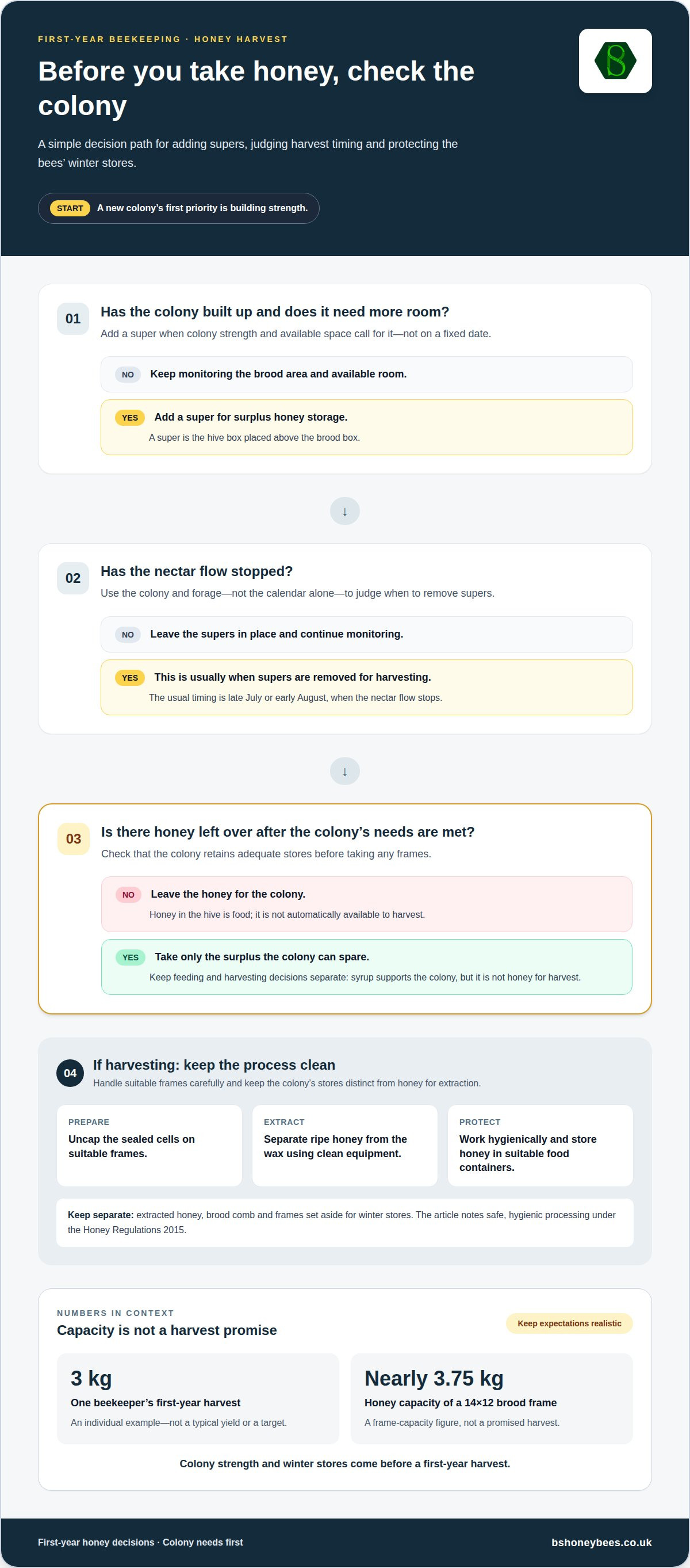
A super is a hive box placed above the brood box for bees to store surplus honey. Add one when the colony has built up and needs room, rather than following a fixed date. Timing depends on colony strength, forage and the space already available. Honey supers are usually removed for harvesting in late July or early August, when the nectar flow stops. Before taking frames, make sure the colony retains adequate stores: honey in the hive is food, not automatically a harvest.
For a first-year beekeeper, the key decision is whether the colony has produced surplus honey after its needs are met. One beekeeper’s first-year harvest was 3kg, but that is an individual example, not a typical yield or target. Weather, forage and colony development all affect the result. Artificial feeding supports the colony, but syrup is not honey for harvest. Keep feeding and harvest decisions separate.
Honey extraction
Honey extraction is the process of removing ripe honey from comb and separating it from the wax. Once suitable frames are removed, uncap the sealed cells and extract the honey using clean equipment. A 14×12 brood frame can hold nearly 3.75 kg of honey, but that figure describes capacity, not a promised harvest. Keep extracted honey separate from brood comb and frames set aside for winter stores.
Work carefully and hygienically. According to the UK legislation register, honey should be processed safely in hygienic conditions following the Honey Regulations 2015. Keep equipment clean, protect open honey from contamination and store the finished product in suitable food containers. Disease management and Varroa treatment also matter to colony health, so plan them around the bees’ needs rather than the convenience of harvesting.
Honey hunting means collecting honey from a natural nest rather than from managed hive frames. Modern frame hives let beekeepers remove comb more selectively, but the key decision remains the same: take only honey the colony can spare. A first-year colony may need its stores more than it needs to provide a harvest, so assess its condition before removing any frames.
For a flavour comparison after your own harvest, explore English honey. Use the season’s experience to note which forage supported the colony and when supers filled. Those observations can help you plan future harvesting, while keeping colony strength and winter preparation at the centre of each decision.
Recognising queen cells and swarm preparations
A queen cell is a specially shaped wax cell in which a new queen develops. In spring and summer, recognising developing queen cells helps you judge whether a colony may be preparing to swarm.
Spring and summer swarm control
Swarm control means managing a colony that is preparing to divide and leave with its queen. During spring and summer, inspect the brood box and look for queen cells, especially along the lower edges of comb. An empty queen cup is only a starting point; a developed cell containing a larva and royal jelly is a stronger sign of active queen rearing. Check the frames carefully before deciding what the colony is doing.
Look for several signs together. A crowded brood box, reduced laying space and queen cells can indicate swarm preparations, while a single empty cup on its own tells you less. Inspect at least every seven days, or every four to five days for colonies at higher risk of swarming. These intervals help you notice changes before a queen cell is sealed, when the colony’s preparations may already be advanced.
Swarm prevention and bait hives
Swarm prevention means reducing the conditions that encourage a colony to divide, while a bait hive offers scouts a potential nesting place. Give a growing colony suitable space and assess its brood frames during inspections. A strong nectar flow can accelerate colony growth, so pay close attention to available room and queen-cell development in spring.
A bait hive does not replace inspections of the occupied brood box. Place a suitable empty hive in the apiary as a possible home for a passing swarm, but keep checking the established colony for queen cells. Bees choosing a bait hive does not prevent another colony from swarming, and an empty bait hive does not control queen rearing inside your own hive.
A colony preparing to swarm may change its behaviour as well as its comb. A cluster at the entrance can signal congestion or a swarm in progress, but entrance activity alone does not confirm the cause. Check the frames and assess queen cells, brood space and colony strength together. Record what you see, including whether cells are empty, contain larvae or are sealed. These notes give you a clear point of comparison at each inspection and help distinguish new development from cells already present.
Swarm control depends on the colony’s condition, not just the calendar. A colony with expanding brood and limited space needs a different response from one with no developing queen cells. If you find charged cells, don’t mistake them for decorative wax cups: assess the whole brood area and make a considered management decision. Keep inspections calm and efficient, returning frames in their original order to keep the brood nest organised.
For a first-year beekeeper, the practical aim is early recognition. Combine regular frame inspections with observations at the entrance, then use queen-cell development and available brood-box space to judge the risk. This gives you a sound basis for managing spring and summer swarming without relying on a bait hive alone.
Seasonal weather and inspection conditions
Inspection timing follows colony activity and suitable weather, not a rigid monthly timetable. Conditions can shift quickly in the UK, so assess the day as well as the calendar.
Brood checks and brood-box inspections
A brood-box inspection is a brief examination of frames where the queen lays eggs and young bees develop. Inspections can usually wait until April unless urgent or the weather is warmer than average. The recommended inspection temperature is above 15°C. Choose a calm, suitable day, work steadily through the frames, then return each one in its original order.
During spring brood checks, look for eggs, larvae and sealed worker brood. A ratio of about 1:2:4 for eggs, larvae and sealed worker brood is a reassuring sign of a well-laying queen. Also note the colony’s stores and whether brood is expanding across the frames. Foundation is a wax sheet fitted into a frame to guide comb building; record whether bees have drawn it out.
Regional calendar variation
The first-year calendar varies across England, Scotland, Wales and Northern Ireland because inspection timing depends on local weather and colony activity. Use the same practical criteria in each nation: suitable temperatures, active bees and a clear reason to inspect, rather than assuming one fixed spring date applies everywhere.
An April date alone, for example, does not make an inspection suitable if the weather is cold. Conversely, an urgent concern may need attention outside the usual seasonal pattern. Keep a record of inspection dates, weather and brood development; comparing these details shows how your apiary’s season is progressing.
Plan each inspection around a specific purpose, such as checking brood, stores or available space. This keeps the hive open only as long as needed and makes observations easier to compare. A brief note about the weather and frames inspected can help explain changes in colony development between visits.
Regular checks matter during the active season, when a colony’s brood area and stores can change. Inspect at least every seven days, or every four to five days for colonies at higher risk of swarming. Use these visits to check for changes in brood, queen-cell development and available space, rather than opening the hive without a clear aim.
Weather also affects what you can learn at the entrance. Before opening the hive, observe returning bees carrying pollen, flight activity and congestion. These signs provide context, but they do not replace checking frames when an inspection is appropriate. Record what you see, then use the next suitable visit to assess changes in brood expansion, stores or colony behaviour.
Keep seasonal notes specific: write down the date, temperature conditions, brood pattern and whether foundation has been drawn. A record from one inspection provides a useful comparison at the next visit, especially when spring weather delays regular checks. In every UK nation, make decisions based on the colony and conditions in front of you.
Varroa monitoring and treatment
Varroa mites are parasites that weaken honey bee colonies, so monitoring and treatment belong in the annual management plan. Start monitoring in May, then use the results and seasonal timing to guide decisions.
Varroa counts and monitoring
Varroa monitoring means checking for mites and recording the results. Begin in May, as the colony enters its active season, and note the date, method and count each time. Keeping a record helps you see whether mite levels are changing, rather than relying on a single observation. Monitoring provides information to plan care; it does not itself remove mites.
Continue assessing the colony’s condition as summer progresses. In August, honey harvest may coincide with decisions about late-season management, so keep harvest plans and monitoring records together. Don’t treat a single count as the whole picture. Repeated results, colony development and the time remaining before winter all inform the next step.
Varroa treatment
Varroa treatment is the use of a control measure to reduce mites in a colony. The calendar recommends applying oxalic acid treatment in UK hives between 10 and 25 December. Treat this as a specific winter timing recommendation, not a substitute for monitoring earlier in the year.
Plan autumn care around the colony’s seasonal needs. After the main honey harvest, assess monitoring results and organise any required treatment and feeding. Use thick sugar syrup in late summer and early autumn if stores need replenishing; fondant can be used from October. Keep the purposes distinct: feeding supports winter reserves, while Varroa treatment targets mites.
Keep a simple apiary record for each colony, including its May monitoring result, later counts, harvest timing and treatment date. For example, a May entry and an autumn entry make it easier to compare observations and see when management changed. Record which treatment was used, too, so the winter plan reflects the colony’s history rather than the calendar alone.
Don’t let harvest plans displace mite management. If a colony is still being monitored after honey removal, record the transition and plan its autumn care promptly. Winter preparation involves several distinct tasks: mite management, feeding and securing equipment. Treat the calendar as a sequence of decisions, not a single treatment date.
Regular access to frames makes colony checks more practical. If you’re preparing an apiary for routine inspections, explore British National hives and frames as part of your equipment planning.
BS Honey Bees
BS Honey Bees Ltd can help you plan the next practical step for your apiary. If you’re preparing to establish a colony, consider its 5 / 6 Frame Nucs; if you’re choosing a queen, explore F1 Buckfast Queens or Carniolan Queens.
For equipment planning, 2 in 1 Poly Nucs offer another option to consider alongside your colony setup. Match your choice to your beekeeping plans and the hive format you intend to use generalised across your site.
Contact BS Honey Bees Ltd to discuss the bees or equipment that fit your plans.
Make your next season a confident one
Your first season is a chance to learn how your apiary responds to its surroundings. Keep a working record of decisions and observations, then use it to shape plans for the next season. The first-year beekeeping timeline in the UK is a guide, not a substitute for noticing what your colony needs. Local weather, forage and colony behaviour all influence the work ahead.
Before taking your next step, decide what you want to establish: a suitable starting colony, a queen choice or equipment that fits your plans. Having this clear makes it easier to prepare for the beekeeping season and focus on steady colony development.
BS Honey Bees Ltd offers F1 Buckfast Queens, Carniolan Queens and 5 / 6 Frame Nucs for beekeepers planning their apiary. Contact BS Honey Bees Ltd for advice. With a clear plan and attentive care, you can build experience season by season and give your bees a strong start.
Frequently Asked Questions
Can I start beekeeping at any time of year?
You can prepare at any time, but plan your start around giving the colony a chance to build up before winter. May or June is a practical arrival period for a beginner’s nucleus colony in the UK. Use the months beforehand to choose a hive format, prepare its site and learn how you’ll organise inspections. If you’re starting later, plan for the colony’s immediate needs and the approaching season.
Should I buy the hive before the bees?
Yes, have the hive ready before your bees arrive. This lets you transfer a nucleus colony into its intended home without leaving equipment assembly until arrival day. Choose the hive format first, then make sure its brood box and frames suit the colony you’re getting. Set up the hive in its planned position and prepare basic protective equipment, a smoker and a hive tool before the transfer.
What should I be doing in the apiary right now?
In November, focus on winter readiness rather than routine inspections. Check from outside that the hive is stable, secure and unobstructed, and look for signs of disturbance after strong weather. Prepare spare equipment for storage and keep your inspection notes together for spring. Avoid opening the hive simply out of curiosity in cold conditions; act when there is a clear concern about the colony or its surroundings.
What about bee diseases and pests?
Make colony health part of every inspection, not a separate seasonal afterthought. Record unusual changes in brood, adult bee numbers, comb or activity, and compare them with your previous notes. Varroa is a key pest to monitor, but the colony’s general condition also matters when assessing risk. Keep equipment clean between colonies and consider the origin and condition of comb or frames before moving them.
When does the bee season start in the UK?
There isn’t one fixed start date across the UK: the season develops with local weather and forage. Bees may become more active as temperatures rise and flowers provide nectar and pollen, while cold spells can slow colony growth. For beginners, May or June is a practical time to receive a nucleus colony. Let conditions and bee activity guide your first planned inspections, rather than treating a calendar date as a signal to open the hive.
When does the beekeeping season end?
The active season winds down as forage declines and colonies shift towards winter survival. The timing varies with local weather, available flowers and the colony’s condition, so there is no single end date. After the main honey flow, attention shifts from expansion to assessing stores, managing late-season health and securing equipment. Continue observing the hive externally through winter, when disturbance or weather damage may need attention.
Why do bees swarm?
Swarming is a colony’s natural way of reproducing: part of the colony leaves with the old queen, while the remaining bees raise a new queen. It often happens as a strong colony expands in spring or summer. Crowding, available space and developing queen cells can indicate preparations, but one sign alone may not explain the colony’s behaviour. Regular, purposeful inspections help you spot changes before a swarm departs.
What is the month-by-month first-year beekeeping timeline in the UK?
Use the months as prompts, not fixed deadlines. Prepare equipment before the bees arrive, with May or June a practical time for a beginner’s nucleus colony. In spring and summer, track brood development and swarm preparations. Monitor for Varroa in May, then assess honey and colony needs as the season progresses. Prepare winter stores in late summer and early autumn; fondant can be used from October. Check hive security in December and remember that January stores are important.