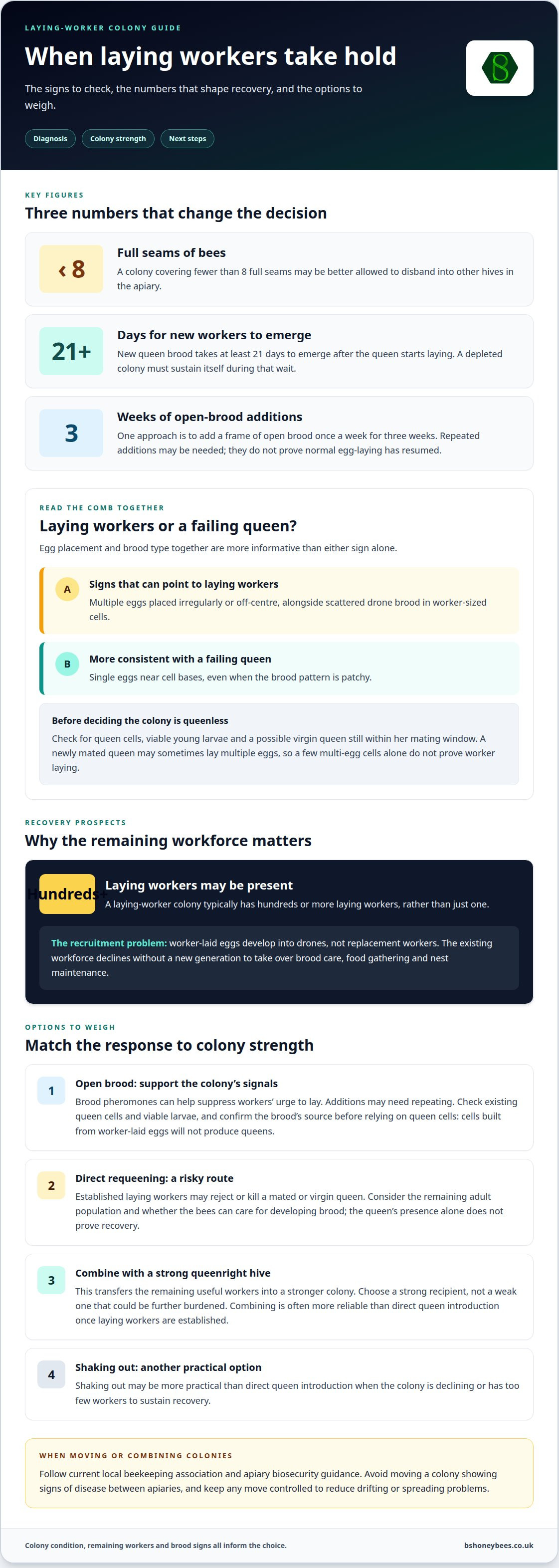
A laying-worker colony can sometimes be saved, but combining it with a strong queenright hive or shaking it out is often more reliable than introducing a queen directly. Dealing with a laying worker hive starts with confirming the cause: multiple eggs placed off-centre and scattered drone brood can point to laying workers, while a failing queen is more likely to lay single eggs near cell bases. Before requeening, check for queen cells, young larvae and a possible virgin queen.
It’s understandable to look for a way to keep the colony intact, especially after investing time in building it. The challenge is that worker-laid eggs develop into drones, so the colony cannot replace its ageing workers with a new generation.
This guide explains how to distinguish laying workers from a failing or drone-laying queen, what affects the colony’s chances of recovery, and which options to consider next. It also covers when adding open brood may help, and when combining or shaking out is more practical.
Key Takeaways
- Look at egg placement and brood pattern together: multiple off-centre eggs and scattered drone brood can point to laying workers, but a failing queen can also produce poor brood.
- Before deciding the colony is queenless, check for queen cells, young larvae and signs a virgin queen may still be within her mating window.
- Open brood can help suppress laying workers, though repeated additions may be needed and recovery depends on the colony’s condition.
- Directly introducing a queen is often less reliable once laying workers are established; consider whether combining with a strong queenright hive or shaking out is more practical.
- Assess the colony’s strength and remaining worker population before choosing a course, as a declining colony cannot raise replacement workers from worker-laid eggs.
Laying workers or a failing queen?
Multiple eggs placed irregularly in cells, together with patchy drone brood in worker-sized comb, can indicate laying workers. A failing queen can also produce a poor brood pattern, so check egg placement and brood type before deciding what is happening.
Queen loss and absent open brood
Laying workers are unmated adult female bees that lay unfertilised eggs, which develop into drones. After queen loss, the absence of queen and open-brood pheromones can allow workers’ ovaries to develop. This usually takes several weeks, so a queenless colony may still have time to raise a replacement queen if suitable young brood remains.
Open brood matters because its pheromones help suppress workers’ urge to lay. Without those signals, the colony can move towards worker laying, particularly if it has also lost its queen. A newly mated queen may occasionally lay multiple eggs, so that sign alone doesn’t prove the colony has laying workers. Check for queen cells and viable young larvae, and consider whether a virgin queen could still be within her mating window.
Once worker laying is established, the colony faces a recruitment problem. Worker-laid eggs produce drones, not replacement workers, so the existing workforce declines without a new generation to take over. The colony may persist for a time, but drone-only brood cannot restore its ability to gather food, care for brood and maintain the nest.
Signs of worker-laid eggs and brood
Look for multiple eggs per cell, especially when they sit off-centre or on the cell walls rather than neatly at the base. Workers often cannot reach the bottom of normal-depth cells, which explains this irregular placement. A failing queen is more likely to leave single eggs near cell bases, even when the brood pattern is patchy.
Then inspect the brood across the comb. Laying workers often produce scattered drone brood in worker-sized cells rather than a consistent area of worker brood. This combination of irregular eggs and drone brood is more informative than either sign alone. A newly mated queen can lay several eggs in a cell, so don’t remove the queen or assume worker laying based on just a few multiple-egg cells.
Workers may remove some worker-laid eggs because they lack the egg-recognition pheromone normally deposited by a queen. As a result, egg numbers can vary between cells and inspections. A laying-worker colony typically has hundreds or more laying workers, not just one. Scattered drone brood in worker comb is a sign worth checking when assessing the colony.
Using brood frames or queen cells
A frame of open brood can help suppress worker laying because brood pheromones influence workers’ reproductive behaviour. Additions may need repeating: one approach is to give the colony a frame of open brood once a week for three weeks. This aims to change the colony’s signals, but it doesn’t prove that normal egg-laying has resumed.
Brood frames can also provide young larvae if the colony is still able to raise a queen. First look for existing queen cells and viable larvae; their presence may mean the colony is already attempting recovery. Queen cells built from worker-laid eggs won’t produce queens, because those eggs are unfertilised and develop into drones. Check the source of the brood before relying on queen cells to restore the colony.
Can a laying worker colony be saved?
Sometimes, but established laying workers make direct requeening risky. The decision depends on the colony’s strength, how long it has declined, and whether a stronger hive can receive it.
When moving or combining colonies in the UK, follow current local beekeeping association and apiary biosecurity guidance. Avoid moving a colony showing signs of disease between apiaries, and keep any move controlled to reduce the risk of bees drifting or spreading problems.
Assessing colony strength and prospects
Assess strength by estimating how much of the comb is covered with bees and whether the colony can sustain brood care. A colony covering fewer than 8 full seams of bees may be better allowed to disband into other hives in the apiary. Also consider whether its population has already fallen after weeks without worker brood.
Worker-laid eggs produce drones, so they can’t rebuild the workforce. Even if a queen is accepted, the colony must wait for her to lay and for new workers to develop. New queen brood takes at least 21 days to emerge after she starts laying. That delay matters when few workers remain to maintain the nest and care for brood.
Requeening a laying-worker colony
Requeening means introducing a queen to restore normal worker production, but a laying-worker colony often rejects or kills a mated or virgin queen. Direct introduction is especially risky when laying workers are established or the colony is weak. Don’t treat the queen’s presence as proof of recovery: the colony still needs to accept her and raise replacement workers.
If attempting requeening, first consider whether the colony can support the queen and her developing brood. A queen’s first worker brood takes time to emerge, so a depleted colony may continue declining during that gap. The deciding factors are the remaining adult population, the extent of worker laying, and whether the bees can care for brood.
Combining or shaking out the colony
Combining transfers the colony’s remaining useful workers into a stronger, queenright hive. Choose a strong recipient colony, not a weak one that could be further burdened. This is often more reliable than direct queen introduction when laying workers are established. Follow local guidance for moving or combining, particularly where disease concerns affect the apiary.
Shaking out disperses the bees so non-laying workers can fly back to the original hive stand. The suggested method is to shake them out in the evening, around 200 yards from the original site. This leaves the beekeeper to decide what to do with the empty equipment and laying-worker brood; remove that brood before introducing a queen to the remaining colony.
Where requeening is a sensible route, compare suitable F1 Buckfast or Carniolan queens with the colony’s condition and recovery plan. A queen alone can’t compensate for a workforce too small to care for her brood.
Distinguishing laying workers from a drone-laying queen
Check egg placement, brood and signs of queen activity together before choosing a treatment. Multiple eggs alone don’t confirm laying workers, and a virgin queen may still be establishing herself.
Worker laying and a failing queen
A drone-laying queen usually lays one egg per cell, while laying workers often leave several, sometimes on cell sides. This distinction matters because a failing queen may still be present and laying, even when brood is patchy. Look at egg position and the brood pattern across several frames, rather than treating one unusual cell as proof.
A failing queen is more likely to place single eggs near cell bases. Drone brood in worker-sized cells can occur with either a failing queen or laying workers, so it isn’t enough on its own to identify the cause. Consider whether eggs appear consistently singly or irregularly, and look for queen cells, young larvae or evidence of a virgin queen.
Checking for queenlessness
Before treating the colony as one with laying workers, check for the queen, queen cells and viable young larvae. This matters because a virgin queen may still be within her mating window, and the colony could be preparing to replace a failed queen.
Inspect brood frames carefully, including their edges and the centre of the brood nest. If you find queen cells or young larvae, don’t assume worker laying has taken over. A newly mated queen can also lay multiple eggs temporarily. Reassess the overall pattern: a queen’s single eggs near cell bases differ from irregularly placed worker-laid eggs.
Allow for the colony’s recent history. Laying workers usually develop several weeks after queen and open-brood pheromones have been absent. A colony that has only recently lost its queen may therefore be queenless without having established laying workers. Look at the sequence of events, not just the eggs seen at the latest inspection.
If a queenless colony has established laying workers, direct introduction of a mated queen is risky: workers may kill her. Prepare the colony by feeding it and providing drawn comb if possible. After removing laying workers, leave the colony queenless for a few hours to a day before offering a queen cell or another queen.
For a caged queen, place the introduction cage in the centre of the brood nest, between the frame top bars, with the candy end down. This gives the queen a central position within the colony. Monitor the brood pattern after introduction: successful acceptance must lead to eggs and developing worker brood, not just the queen’s presence in the hive.
Recognising multiple eggs and irregular egg placement
To identify a laying-worker hive rather than a queenright one, inspect egg placement alongside the brood pattern. A queen usually lays one egg neatly at the base of a cell; multiple eggs alone are not conclusive.
Multiple eggs in a cell
Multiple eggs in one cell are a clue, especially when they appear across several brood cells rather than in an isolated example. They matter because worker-laid eggs are often scattered and irregularly positioned, unlike the usual pattern of a queen’s single, centred egg.
Check whether eggs sit at the cell base or on its walls. A worker may not reach the bottom of a normal-depth cell, leaving eggs off-centre or along the sides. A newly mated queen can occasionally lay multiple eggs, so don’t diagnose laying workers from one cell or one inspection alone.
Compare several areas of the brood nest. For example, note whether neighbouring cells each contain one egg or whether multiple eggs recur across the comb. Workers may remove some worker-laid eggs because they lack the recognition pheromone normally deposited by a queen. That can leave an uneven pattern, so weigh the combined signs rather than relying on a single cell.
Irregular placement and other signs
Irregular placement means eggs sit away from cell bases, often on the sides. It becomes more significant when paired with scattered drone brood. This combination helps distinguish worker laying from a queenright colony, where the queen’s eggs are normally placed neatly at cell bottoms.
Inspect the brood for drones developing in worker-sized cells. Scattered drone brood in those cells can indicate laying workers or a failing queen, so interpret it alongside egg placement. A drone-laying queen usually lays one egg per cell; laying workers often leave several eggs, sometimes in different positions.
Compare the comb frame by frame rather than relying on a quick glance. Look first at the eggs, then check whether the resulting brood is drone brood scattered through worker comb. A poor or patchy brood pattern alone doesn’t settle the diagnosis: a failing queen may still lay single eggs near cell bases. The pattern across the comb provides better evidence than one unusual patch.
Record what you see at each inspection, including whether eggs are single or multiple and where they sit. Compare your notes with the next brood check. Consistently orderly egg placement points away from established worker laying; persistent irregular eggs with scattered drone brood strengthens the case for it.
What to do with a laying worker hive
Once worker laying is established, choose between attempting recovery, combining, or shaking out. When dealing with a laying worker hive, base the decision on whether enough healthy workers remain to support a queen and developing brood.
Start with the colony’s strength and the time it has spent without a queen. A colony with fewer than 8 full seams of bees may be better allowed to disband into other hives in the apiary. If its population has already fallen over several weeks, a recovery attempt may demand more resources than the colony can provide.
- Consider recovery if a substantial workforce remains and repeated open-brood additions are practical.
- Consider combining if useful workers remain but the colony cannot support its own recovery.
- Consider shaking out if laying workers are established and the colony is weak or declining.
Combining is generally more reliable than introducing a queen directly to an established laying-worker colony. Use a strong queenright recipient, not a weak hive that may struggle with the added bees. This preserves workers that can return to useful colony work, rather than asking a small, failing colony to rebuild alone.
Shaking out separates the bees from the original hive. The suggested approach is to do this in the evening, around 200 yards from the original site. Non-laying workers are expected to fly back to the original stand. Remove laying-worker brood before introducing a queen to any remaining colony, as it cannot produce replacement workers.
If you choose a recovery attempt, add open brood to supply brood pheromones and assess the response before escalating. Repeated additions may be needed. A queen cell or queen introduction is not a shortcut if laying workers remain established: the colony may reject a queen, and any accepted queen still needs time to produce worker brood. New workers take at least 21 days to emerge after she starts laying.
A careful plan for dealing with a laying worker hive weighs the remaining workforce against the time and resources recovery requires. A strong recipient colony can make combining worthwhile; a small population with no route to raise workers points towards shaking out. If requeening fits the recovery plan, explore queen options once the colony is ready to receive one.
BS Honey Bees: F1 Buckfast Queens
BS Honey Bees Ltd offers F1 Buckfast Queens for beekeepers planning to requeen a colony once it’s ready to receive a queen. Carniolan Queens are another option to consider when selecting a queen for a recovery plan. A queen introduction should follow the colony assessment, not replace it: established laying workers can make acceptance difficult, and the remaining bees must be able to care for developing brood.
If the colony is too depleted to rebuild effectively, a 5 / 6 Frame Nuc may provide an alternative starting point. Match the choice to your apiary’s needs and the condition of the hive, rather than assuming every laying-worker colony can be restored. Contact BS Honey Bees Ltd to discuss the queen or nuc options for your next step.
Plan your next apiary decision
Before your next inspection, decide what outcome you’re working towards: preserving the colony, strengthening another hive, or clearing the way for a fresh start. That choice gives each action a purpose and helps you avoid extending a recovery attempt when the remaining bees can’t support it. Keep a simple record of your decision and what you observe next, so your plan responds to the colony rather than guesswork.
A considered approach to dealing with a laying worker hive also protects the wider apiary. Think about which colonies could receive returning bees, whether equipment needs attention, and how your chosen course fits your beekeeping plans. A clear decision now makes the next inspection more focused and helps you move forward with confidence.
For a practical next step, contact BS Honey Bees for beekeeping help. Take your time, make a clear plan, and keep building a stronger apiary.
Frequently Asked Questions
Why do worker bees start laying eggs and how long does it take?
Workers may begin laying after queen and open-brood signals have been absent for several weeks. Queen loss removes the queen’s influence, while the absence of open brood means fewer brood pheromones to suppress worker laying. The change doesn’t happen immediately, so a colony that has recently lost its queen may still have time to raise one. Check for queen cells and suitable young larvae before deciding worker laying is established.
What are the step-by-step methods to fix a laying worker hive?
First, inspect for a queen, queen cells and viable young larvae; don’t act on multiple eggs alone. Next, assess the colony’s strength and whether it can support recovery. If enough bees remain, add open brood to provide brood pheromones. If the colony is weak or laying workers are established, consider combining it with a strong queenright hive or shaking it out. Avoid making direct queen introduction your first move.
Does adding a frame of eggs and young larvae help a laying worker hive, and how often?
Yes, a frame containing open brood can provide pheromones that suppress worker laying. One approach is to add a frame of open brood once a week for three weeks. Use brood with young larvae, not just sealed brood, and check the colony’s response between additions. This method may need repeating; it doesn’t guarantee that workers will stop laying or that the colony can raise a queen. Keep assessing its population and brood condition.
Is it better to combine a laying worker hive with a strong colony or introduce a mated queen?
Combining with a strong queenright colony is often more reliable when laying workers are established. A colony with laying workers may kill a mated queen, and a weak recipient may struggle with the added bees. Direct requeening is less suitable if the colony has already lost strength or worker laying is widespread. Base your choice on how many bees remain and whether they can care for brood while replacement workers develop.
How can I safely introduce a queen to a colony with laying workers?
Address the laying workers before placing a queen directly into an established laying-worker colony. After removing laying workers, leave the colony queenless for a few hours to a day before offering a queen or queen cell. Feed the colony and provide drawn comb if possible. Position a queen introduction cage centrally in the brood nest, between frame top bars, with the candy end down.
What are the risks of shaking out a laying worker hive, and how far away should bees be moved?
Shake the bees out in the evening, around 200 yards from the original hive site. Non-laying workers are expected to fly back to that stand, so plan for their return and ensure a suitable queenright colony can receive them. The laying-worker colony itself won’t continue as a functioning hive after the shake-out. Remove its laying-worker brood before reusing the remaining colony for queen introduction.