A swarm can leave with around half a colony’s worker bees, so prevention starts before the hive becomes crowded or queen cells appear. Knowing how to prevent bees swarming means inspecting the brood nest regularly, making room for a growing colony and harvesting honey when supers are full. Once the swarming impulse takes hold, it can be difficult to stop.
Swarming is a natural sign of colony reproduction, but it can leave the parent colony with a queen to raise and a disrupted brood cycle. Smaller secondary swarms can face challenges of their own. Managing space early helps reduce pressure, though no method can remove a colony’s natural urge to reproduce.
This guide explains what prompts a colony to swarm and how timely inspections, extra hive space and honey harvesting can help you respond. It also covers what a queen excluder can and cannot do, and why simply removing queen cells may not solve the problem. Use these practical steps to make informed decisions through the UK swarm season.
Key Takeaways
- Inspect brood frames regularly during swarm season and assess queen cells in context before deciding how to respond.
- Make room ahead of a colony’s spring build-up, including space for brood as well as incoming nectar.
- Harvesting honey and adding supers can ease congestion, but extra super space alone may not free up the queen’s laying area.
- A queen excluder does not remove the colony’s urge to swarm; use it as part of a wider management plan.
- Learn how swarming affects the colony and why early, considered action can help reduce the risks.
Honey bee colony reproduction and causes of swarming
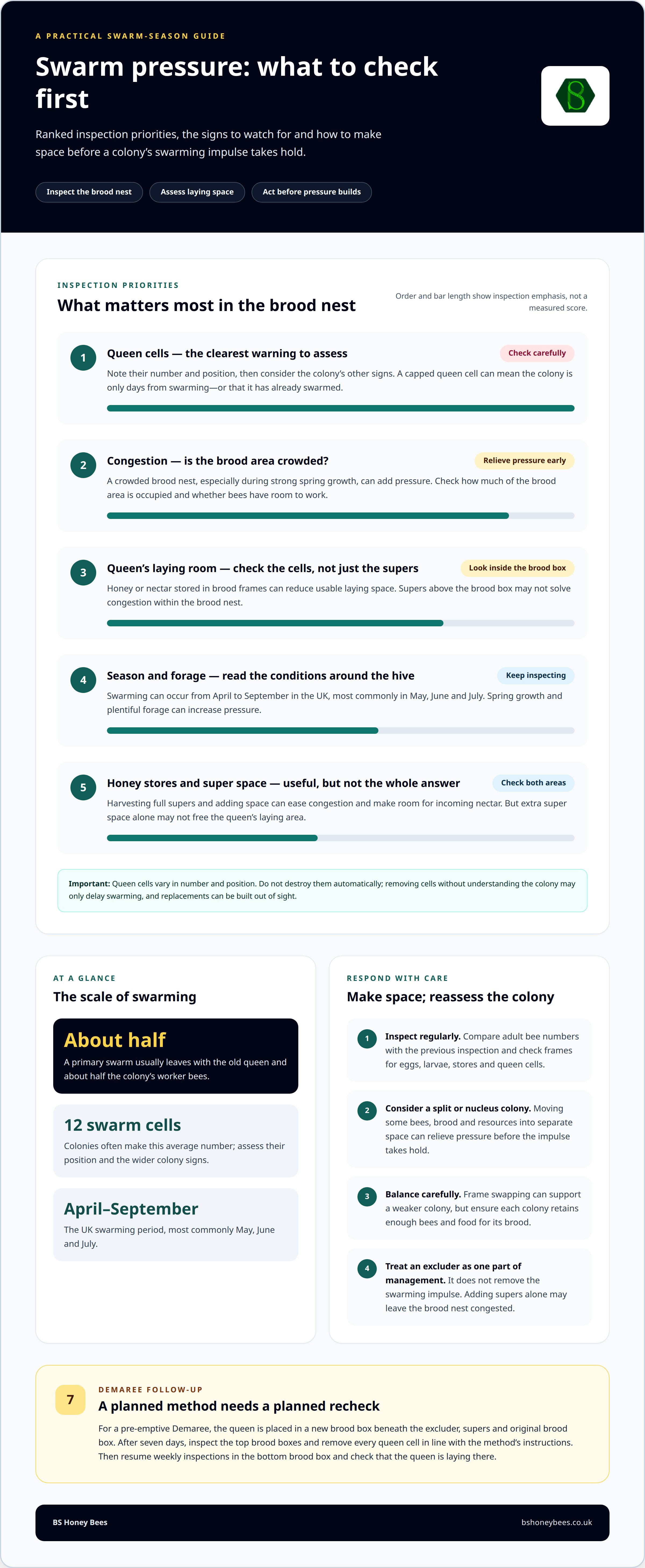
- Understand the colony’s reproductive cycle before changing the hive. Swarming is how a honey bee colony reproduces, a behaviour that has continued for about 20 million years. In the UK, swarming can occur from April to September, most commonly in May, June and July. Spring growth, plenty of forage and a crowded brood nest can increase pressure. A primary swarm usually leaves with the old queen and about half the colony’s workers. Secondary swarms may follow with one or more virgin queens.
- Inspect the brood nest for signs that the colony is preparing to swarm. Look for queen cells, a congested brood area and fewer clear places for the queen to lay. Colonies often make an average of 12 swarm cells, but the number and position of cells matter. Don’t destroy queen cells without understanding why they are there. Once a queen cell is capped, the colony may be only days from swarming, or may already have swarmed.
- Before deciding what to do next, check whether a swarm has already left. Compare the adult bee population with your previous inspection, then examine brood frames for eggs, larvae and queen cells. A sudden drop in worker numbers can indicate a departure. Brood production pauses after a swarm while a new queen emerges, mates and begins laying, so assess a temporary lack of fresh eggs alongside the colony’s other signs.
- Relieve pressure in a strong colony by making a nucleus colony or splitting it before the swarming impulse takes hold. A split gives some bees, brood and resources a separate space, changing conditions in the crowded colony. Frame swapping can also balance colonies: move a brood frame from a strong hive to a weaker one, then replace it with empty comb or a frame fitted with foundation. Ensure each colony retains enough bees and food to support its brood.
- Balance resources across the apiary before one colony becomes overcrowded beside weaker hives. Use brood frames to support a colony that needs them, and move spare supers where bees can draw comb and store incoming nectar. Nurse bees transferred with brood can remain in the receiving hive. Reassess both colonies at the next inspection, checking brood, adult bee coverage and food stores before making further changes.
- For an established feral colony inside a building, use a specialist rather than attempting removal yourself. Professional bee removers can extract live colonies from buildings without pesticides and relocate them without harming the bees. Bee removers should be registered with the National Bee Unit and inform it if foulbrood is suspected. A managed hive can be split or balanced, while a colony established in a wall or chimney needs safe, appropriate removal.
Will a queen excluder prevent swarming?
Early signs include queen cells, a crowded brood nest and reduced laying space. A queen excluder does not remove the colony’s swarming impulse, although its position may give you time to act.
- Inspect the brood nest and assess whether the queen has room to lay. Honey stored in brood frames can reduce usable laying space, even when supers sit above the brood box. Check frames for brood, stores and empty cells, then consider whether congestion is restricting the queen’s space. Adding supers alone may not resolve a blockage in the brood nest.
-
Assess congestion and queen laying space
Look for nectar or honey occupying cells where the queen could lay, and check whether bees cover the brood frames. A crowded nest can contribute to swarm pressure, but adding a super may leave the brood area congested. Plan for space by considering both incoming nectar and the queen’s access to suitable laying cells.
- Identify queen cells before removing any. Note their number, position and the colony’s behaviour. Cells at the frame edges can indicate swarm preparation, while cells elsewhere may have another purpose. Don’t destroy them automatically: removing queen cells alone may only delay swarming, as bees can build replacements in less visible places. Inspect colonies regularly during the swarming season, checking the brood frames carefully.
-
Consider queen age and prevention risks
Include the queen’s age in your assessment. Older queens tend to swarm more frequently, and some beekeepers replace queens every few seasons. Re-queening can be part of a longer-term management plan, rather than a response to queen cells alone. Every intervention has consequences: a poorly managed split can weaken the parent colony, while removing cells without understanding them can leave the colony preparing to swarm.
- Use a queen excluder for its specific role, not as standalone swarm control. An excluder at the bottom of the brood box or along the entrance does not stop the urge to swarm, but may give you time to split the hive. For a pre-emptive Demaree, place the queen in a new brood box beneath the excluder, supers and original brood box. This separates the queen from the brood while keeping the colony organised.
- Schedule the follow-up before setting up a Demaree. After seven days, inspect the top brood boxes and remove every queen cell, following the method’s instructions. Then resume weekly inspections in the bottom brood box and check that the queen is laying there. If re-queening is part of your plan, explore F1 Buckfast and Carniolan queens as potential options for your apiary.
Harvesting honey to create space
- Assess the colony’s space before the main UK swarm season. Honey bees can swarm from April to September, most commonly in May, June and July. Check whether bees are occupying the available supers and whether the brood nest is congested. A hive may have room above the brood box but little space for the queen to lay. This distinction helps you identify whether the colony needs more honey-storage space, brood space or both.
- Add a honey super before the existing capacity is full. A first super can increase hive capacity by about fifty per cent, giving workers more room to store incoming nectar. Add another as soon as the current super is occupied, rather than waiting until every frame is packed. During a strong nectar flow, waiting too long can leave bees short of storage space. Extra super space can ease pressure, but it will not necessarily resolve a congested brood nest.
- Harvest honey only when it is ready, then use the cleared super to restore storage capacity. Check frames for capped honey and avoid taking stores the colony needs. Removing a full super creates room for incoming nectar, but timing should suit the available forage and the colony’s condition. If bees are still filling the remaining super, prepare another rather than leaving the hive short of space during an active flow.
- Use each inspection to identify the cause of crowding. Honey bees may store nectar in brood frames, reducing the queen’s laying area even when supers are present. Check brood frames for stored honey, open cells and brood, then decide whether the brood nest needs attention as well as honey harvesting. A queen excluder will not create laying space inside the brood box. If congestion remains, address it separately instead of relying on another super alone.
- Consider swarm management and honey production together. Swarming is colony reproduction, often prompted when a growing colony faces crowding during good forage. Regularly assess super occupancy and brood-space conditions throughout the season, especially as spring growth accelerates. For UK bee management, register colonies on BeeBase. If foulbrood is suspected, inform the National Bee Unit. These steps concern colony management and disease, not a reporting procedure for honey harvesting.
Is it possible to stop swarming without splitting?
Inspections, space management and fresh comb can reduce swarm pressure without splitting, but swarming remains a natural colony instinct. If you’re considering how to prevent bees swarming without a split, the right approach depends on your experience and hive setup. Beginners often favour an artificial swarm, while experienced beekeepers may use methods such as Demaree when the colony is suitable.
-
Inspect brood boxes routinely
Inspect brood boxes every seven days during the main spring build-up, looking for queen cells, brood coverage and room for laying. During swarm season, inspections every seven to ten days help you spot changes before they develop. Record what you find, including whether the queen is laying and whether bees are storing nectar in brood frames. Don’t rely on a quick look at the hive entrance.
-
Relieve congestion and provide space
Assess how much room the colony has for brood and incoming nectar, then address the type of congestion you find. Adding a box is a common way to create space and work for bees, but extra super room does not always resolve a packed brood nest. If honey occupies brood cells, the queen may have fewer places to lay. Consider brood space and honey-storage space together.
-
Rotate brood frames and draw fresh comb
Rotate selected brood frames and replace them with empty frames to encourage bees to draw fresh comb. Make changes carefully, keeping the queen’s laying area and the brood arrangement in mind. New comb gives the queen potential laying space, while bees can use it as the colony expands. Avoid breaking up the brood nest unnecessarily, especially when weather or colony strength makes the bees vulnerable.
- Use the colony’s brood volume to judge whether it needs more room. One beekeeper’s estimate is that four frames of sealed brood can become the equivalent of eight frames of bees by the next inspection. This growth shows why preparation matters: space added only after congestion appears may come too late. Check the brood area again at the next visit and adjust according to what the bees have occupied.
- Choose a swarm-control method that suits your experience and hive arrangement. An artificial swarm is described as one of the most reliable options for beginners because it separates the queen and flying bees from the brood. Experienced beekeepers may use the Demaree method, which can also work on double-brood setups. Pre-emptive Demaree is intended for big, strong colonies, not small or struggling ones.
- For a suitable double-brood colony, treat Demaree as a planned manipulation, not a last-minute fix. Place the queen in a new brood box beneath a queen excluder, supers and the original brood box. Inspect the upper brood boxes seven days after setup and remove every queen cell. Continue checking the bottom box for the queen’s laying activity, and record fresh observations at each inspection. This preparation is central to how to prevent bees swarming without splitting.
Risks of allowing bees to swarm
- Assess what the parent colony loses when a swarm leaves. A primary swarm usually takes the queen and about half the workers, reducing the adult population available to forage, care for brood and defend the hive. This loss can affect the colony’s ability to make use of a nectar flow. The impact depends on the bees that remain, their stores and the brood still developing.
- Account for the pause in brood production after a swarm. The remaining colony must raise a new queen, who has to emerge, mate and begin laying before normal brood production resumes. During this transition, fewer young bees may emerge to replace ageing workers. Check the remaining brood and food stores, then assess the colony over subsequent inspections rather than assuming it has recovered.
- Consider the swarm’s prospects outside the apiary. A swarm may contain thousands of bees, but a large percentage of swarms do not survive, particularly smaller secondary and after-swarms. Scout bees search for a suitable home while the swarm clusters, then the bees must establish themselves in a cavity and collect forage. Poor shelter or limited forage can make settlement and survival more difficult.
- Respond promptly if a swarm settles near people or buildings. Keep bystanders away from the cluster and avoid disturbing it: the swarm may move on once scouts find a new home. If it poses a stinging risk, arrange appropriate assistance rather than trying to handle the bees. A swarm in a wall or chimney is different from a temporary cluster and needs a suitable removal approach.
- Manage collected swarms with disease risk in mind. Honey bee swarms can spread disease, so keep a swarm collected from an area with disease in an isolation apiary until it is confirmed disease-free. Don’t place it directly beside established colonies. This protects the wider apiary while the swarm’s health is assessed and its behaviour and development become clearer.
- Weigh these consequences against the colony’s natural reproductive behaviour. Swarming is not automatically a failure, but leaving a hive unmanaged can mean fewer workers, a brood interruption and a swarm exposed to hazards. Use timely inspections and suitable prevention to reduce avoidable losses, then plan ahead for your apiary before swarm season brings pressure.
BS Honey Bees Ltd.
BS Honey Bees Ltd offers practical options for beekeepers managing colony numbers and planning ahead for swarm season. If re-queening forms part of your longer-term approach, F1 Buckfast Queens and Carniolan Queens are available. For apiary management or establishing another colony, explore 5 / 6 Frame Nucs and 2 in 1 Poly Nucs.
These products support different decisions: queens can provide a route to replacing a colony's queen, while nucs give you a separate nucleus colony to manage. Choose according to your apiary plans and the needs of your colonies, alongside regular inspections and suitable space management.
For information about these options, contact BS Honey Bees Ltd.
Plan your next move before swarm pressure builds
Make your next inspection part of a deliberate apiary plan. Keep a short record of each colony’s condition and changes, so decisions reflect its development rather than a single observation. Knowing how to prevent bees swarming means staying attentive and choosing a response that suits the colony in front of you.
Use your records to decide what needs attention next: colony strength, development or your apiary plans. If you’re considering changes to your colonies, equipment or future beekeeping plans, take the next step with a clear purpose.
Discuss your plans with BS Honey Bees Ltd and move forward with confidence.
Frequently Asked Questions
What causes a beehive to swarm?
Swarming is a colony’s natural way of reproducing, often encouraged by a crowded brood nest during spring or summer. Limited laying space and abundant forage can coincide as the colony grows. The queen’s age may also be relevant, as older queens tend to swarm more frequently. Look at the whole picture: colony strength, brood space, stores and queen cells together provide more useful context than one sign alone.
Does adding more supers stop swarming?
No. Supers provide extra room for storing nectar, but they may not ease congestion in the brood nest or create laying space for the queen. For example, a hive can have an empty super above while brood frames below contain stored honey. Check where the bees need space before adding boxes. If the brood area remains congested, address it separately rather than relying on extra honey-storage capacity.
How often should I inspect during swarm season?
Inspect brood boxes every seven days during the main spring build-up, and continue regular checks through swarm season. Seasonal advice often recommends inspections every seven to ten days, but the shorter interval makes it easier to spot changes promptly. Examine frames rather than judging from entrance activity alone. Note queen cells, brood pattern and available laying space, then compare those observations with your previous inspection.
Is it ok to let your bees swarm?
Swarming can happen as part of natural colony reproduction, but it has consequences for both the parent colony and the swarm. The parent must raise a new queen, while the swarm needs to find shelter, establish a nest and collect forage. Smaller secondary swarms can have particular survival difficulties. If a swarm settles somewhere that could put people at risk, keep clear and arrange appropriate help.
Should you remove swarm cells?
Don’t remove queen cells automatically. Their number, position and the colony’s behaviour help determine whether they indicate swarm preparation or another change. Removing cells alone does not reliably prevent swarming, because bees may build more in less visible places. Inspect the full brood nest and choose a management response based on what you find. A capped queen cell means the colony may be close to swarming or may already have swarmed.
What is the best swarm control method?
The right method depends on the colony’s condition, your experience and the hive arrangement. An artificial swarm is described as one of the most reliable options for beginners because it separates the queen and flying bees from the brood. Experienced beekeepers may choose another approach, such as Demaree, for a strong colony. Whichever method you use, follow-up inspections matter: a manipulation does not remove the need to monitor the hive.
What is the preemptive Demaree?
A pre-emptive Demaree is a planned arrangement for a big, strong colony, not a small or struggling one. Place the queen in a new brood box beneath a queen excluder, supers and the original brood box. Inspect the upper brood boxes seven days after setting it up and remove every queen cell. This method separates the queen from much of the brood while allowing the colony to remain in one hive arrangement.
What causes honey bee colonies to swarm?
Swarming happens when a colony reproduces by dividing, rather than because of a single fault in hive management. In the UK, it commonly occurs during the warmer months, when colonies are growing and forage is available. Crowding and restricted brood space can add pressure. Assess queen cells, a packed brood area and honey stored among the brood together when deciding what the colony may be preparing to do.