The central change for honeybee keepers in Great Britain is compulsory registration of honeybee establishments. The UK and EU intend their sanitary and phytosanitary rules to align from 1 March 2028, subject to their procedures. According to the Animal and Plant Health Agency, registration will use an adapted BeeBase system when those arrangements take effect.
If you’re asking what changes for beekeepers on 1st March 2028, the key point is that the arrangements cover small-scale keepers too: guidance applies across the UK, including people with just one or a few colonies. Records for honeybee establishments in Great Britain will also need to be available for inspection.
It’s understandable to want clarity well before the start date. This article explains who the arrangements cover, what registration and record keeping involve, and what remains in place until the change takes effect. It also separates honeybee requirements from other livestock rules introduced as part of the wider arrangements, so you can focus on what matters to your apiary.
Key Takeaways
- Compulsory registration for honeybee establishments in Great Britain is due to begin when the new arrangements take effect on 1 March 2028, using an adapted BeeBase system.
- The arrangements cover beekeepers with one or a few colonies as well as larger holdings.
- Keep apiary locations and colony details accurate, and continue reporting suspected pests and diseases.
- Records for honeybee establishments in Great Britain will need to be available for inspection.
- Until the start date, there are no immediate changes to the rules businesses need to follow.
Registration, identification and record keeping
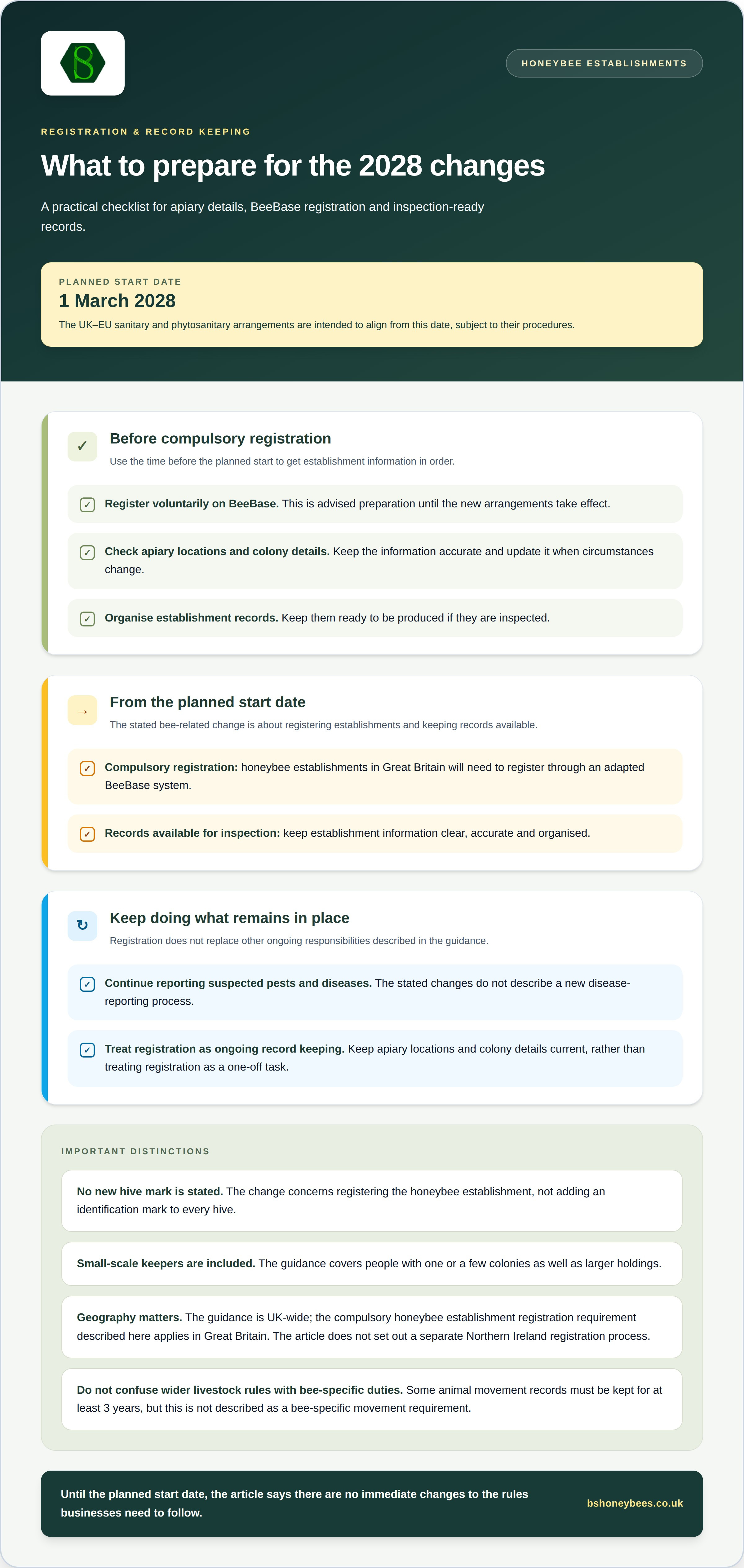
From 1 March 2028, honeybee establishments in Great Britain will need compulsory registration through an adapted BeeBase system. Beekeepers should also keep apiary locations and colony details accurate, and have establishment records ready for inspection.
The change concerns registering and recording establishments, not adding an identification mark to every hive. Prepare by keeping apiary information clear and current, and continue reporting suspected pests and diseases.
Bee registration and hive identification
Bee registration means recording a honeybee establishment on the adapted BeeBase system; the stated change does not introduce a new hive-identification requirement. According to the Animal and Plant Health Agency, registration will become compulsory when the UK-EU sanitary and phytosanitary arrangements take effect. Accurate apiary locations and colony details will help ensure that the information held for each establishment reflects its current situation.
Until then, beekeepers in Great Britain are advised to register voluntarily on BeeBase. Keep the location of each apiary and its colony details up to date as they change. This is useful preparation, not a requirement to add an identification mark to every hive.
Disease reporting and inspections
Reporting suspected pests and diseases continues, while establishment records must be available for inspection under the changes. Maintain accurate apiary locations and colony details rather than treating registration as a one-off task. Clear records can help show which colonies are kept at each apiary if establishment information is inspected.
The stated changes do not describe a new process for reporting bee diseases or a separate inspection schedule. Continue reporting suspected pests and diseases, and keep records organised so they can be produced if required. Registration does not replace reporting concerns about colony health.
Preparing for the changes
Prepare by organising existing apiary information before compulsory registration starts. Register voluntarily on BeeBase, review the accuracy of listed apiary locations and colony details, and update them when circumstances change. These steps apply whether you manage one apiary or several. Keepers with only a few colonies are covered too.
Focus on having accurate information ready rather than assuming a particular charge. Some animal movement records will need to be kept for at least 3 years, but that wider record rule should not be treated as a bee-specific movement requirement.
The changes identified for bees concern establishment registration and inspection-ready records. They do not set out a new rule for moving bees, queens or used equipment. Keepers should distinguish those topics from the wider requirement for some animal movement records to be retained for at least 3 years.
Beekeepers covered by the new arrangements
The arrangements are relevant to beekeepers across the UK, not just commercial operators. Guidance covers keepers with one or a few colonies, so a small apiary is not outside its scope simply because it produces little honey or is kept as a hobby.
There is an important geographical distinction. The guidance covers UK beekeepers, while compulsory registration for honeybee establishments applies in Great Britain. The Animal and Plant Health Agency says registration will use an adapted BeeBase system when the sanitary and phytosanitary arrangements take effect. Distinguish the guidance’s UK-wide audience from the specific Great Britain registration requirement.
Colony numbers do not exempt a beekeeper from the arrangements. Whether you keep one colony, a few hives at home or several apiaries, the guidance is relevant. The scale and purpose of your operation do not change the stated coverage. This matters for smallholders, who may assume that rules for animal keepers concern only larger or commercial holdings.
The wider arrangements also apply to smallholders and animal keepers with only a few animals. This helps explain why small-scale beekeeping is included in the guidance, but it does not mean every livestock rule applies to bees. Identification deadlines for pigs, deer or camelids, for example, are species-specific requirements, not honeybee identification rules.
- One or a few colonies: the guidance still covers the keeper.
- Honeybee establishments in Great Britain: compulsory BeeBase registration is the relevant registration change.
- Other animal species: their identification or movement rules should not be applied to bees without a specific requirement.
For keepers with apiaries on both sides of the Great Britain and Northern Ireland distinction, the facts here establish the registration requirement for Great Britain. They do not set out a separate registration process for Northern Ireland. Keep the geographic scope in mind when identifying which establishment the change concerns.
The concrete duties are compulsory registration and keeping records ready for inspection. The facts do not establish a specific penalty for non-compliance, so no fine or sanction should be inferred. The practical priority is to understand which establishment is covered and prepare accurate information for registration.
Whether you keep one colony or manage several apiaries, identify the scope of your keeping before the arrangements begin. Separate bee-related duties from rules for other livestock, and avoid assuming that small scale creates an exemption. That distinction is the clearest way to understand which keepers the 2028 changes concern.
Compulsory BeeBase registration for honeybee establishments
Registration will move from voluntary preparation to a compulsory requirement for honeybee establishments in Great Britain. According to the Animal and Plant Health Agency, registration will use an adapted BeeBase system when the UK-EU sanitary and phytosanitary arrangements take effect.
The focus of this registration change is the establishment, not a new hive mark. The arrangements also require records for honeybee establishments in Great Britain to be available for inspection. Understand both parts: register the establishment and maintain records that can be produced if inspected.
BeeBase already provides a practical route for voluntary registration before the change. Beekeepers in Great Britain are advised to keep apiary locations and colony details accurate. These records provide a useful basis for preparing establishment information, without assuming particular fields or an application process for the adapted system.
If you keep colonies at more than one apiary, accurate location details help distinguish the sites in your records. When colony details change, update the information rather than relying on an old entry. These are sensible record-keeping steps based on the stated advice, not a claim about the exact data fields in the adapted BeeBase system.
- Registration: honeybee establishments in Great Britain will need compulsory registration through adapted BeeBase.
- Records: establishment records must be available for inspection.
- Preparation: voluntary BeeBase registration and accurate apiary and colony details support readiness.
Do not confuse this requirement with a new identification rule for every hive. The change described by the Animal and Plant Health Agency is compulsory registration of honeybee establishments using adapted BeeBase. It does not specify a separate hive-marking step. Keeping the distinction clear helps prevent unrelated livestock identification rules from being mistaken for bee requirements.
Registration does not replace disease reporting. Beekeepers in Great Britain are advised to continue reporting suspected pests and diseases. Keeping establishment information accurate and reporting concerns are separate responsibilities: one records where colonies are kept, while the other concerns suspected threats to bee health.
Before the arrangements take effect, focus on records that are already relevant: apiary locations, colony details and reports of suspected pests or diseases. The exact data-entry process for the compulsory system is not described, so do not treat an assumed form, identifier or deadline as a requirement. The concrete change is compulsory registration and records for establishments that are ready for inspection.
Bumblebee production holdings will have to be registered and approved before production can begin. Registration of poultry premises will continue to cover small backyard flocks of less than 50 birds. These requirements concern different types of animal premises.
Future guidance and exemptions
Further guidance is scheduled during 2027, ahead of the arrangements’ 1 March 2028 start. This matters because some details concern other animal sectors or biocidal products, not honeybee registration. Separate those rules from the requirements for honeybee establishments in Great Britain.
The government plans to publish explainers for livestock, poultry and pig sectors in spring 2027. More detailed guidance for affected sectors is scheduled throughout 2027. These publications may help explain how wider sanitary and phytosanitary arrangements apply to their relevant keepers. They should not be read as evidence that a species-specific rule also applies to bees.
One unresolved area concerns animal journeys. Final requirements for short journeys, including journeys under 65 kilometres, remain subject to the final arrangements. The 65-kilometre distance is relevant to those journey rules, not a stated exemption from honeybee establishment registration. Keep the two questions separate: registration concerns the establishment, while journey rules concern movement.
Creosote provisions also have separate dates and a different subject. From 1 March 2028, creosote will only be permitted for use on railway sleepers or electricity or telecommunications utility poles. This restriction concerns permitted uses of creosote, rather than registration of a bee colony or apiary.
Transitional arrangements distinguish between products being made available and existing stocks being used. Non-compliant creosote biocidal products may be made available on the Great Britain market until 30 November 2028. Existing stocks of creosote biocidal products that do not meet EU requirements may be used in Great Britain until 30 June 2029. These are different allowances, with different end dates and activities.
A further market date applies to treated articles. After 31 August 2028, treated articles that do not comply with EU biocide rules may no longer be placed on the market. That date concerns placing products on the market; it is not an extension of honeybee registration or a general exemption for beekeepers.
- Spring 2027: planned government explainers cover livestock, poultry and pig sectors.
- Throughout 2027: further sector guidance is scheduled.
- Under 65 kilometres: short-journey requirements depend on the final arrangements.
- Creosote: the permitted uses and transitional dates apply to biocidal products and treated articles.
For beekeepers, the practical distinction is scope. A creosote transition or animal-journey rule does not, by itself, exempt a honeybee establishment from the registration arrangements. Use each 2027 sector explanation for its stated subject, and keep bee registration requirements distinct from product and movement provisions.
The agreement’s 1 March 2028 start date
1 March 2028 is the intended start date for aligning UK and EU sanitary and phytosanitary rules, subject to their procedures. For honeybee keepers in Great Britain, the date matters because compulsory registration of honeybee establishments is due when the arrangements take effect. It marks a planned transition, not a claim that every beekeeping rule changes at once.
If you’re asking what changes for beekeepers on 1st March 2028, the central point is the move to compulsory establishment registration. Until that date, the UK government says businesses face no immediate changes to the rules they need to follow. Continue with the rules already in force, rather than treating future arrangements as current requirements.
When the arrangements take effect, the Animal and Plant Health Agency says registration will use an adapted BeeBase system. Records for honeybee establishments in Great Britain must also be available for inspection. Prepare by keeping apiary and colony information organised, then follow the registration requirements when the arrangements take effect.
The agreement’s date belongs to a wider UK-EU framework, so other provisions have their own scope and timelines. Government explainers for livestock, poultry and pig sectors are planned for spring 2027, with further guidance for affected sectors scheduled throughout 2027. Those publications relate to their relevant sectors. A livestock deadline should not be mistaken for a new honeybee obligation.
The question of what changes for beekeepers on 1st March 2028 also needs to be separated from varroa treatment. The changes described here concern establishment registration and inspection-ready records. They do not state a new varroa treatment rule or a change to permitted medicines. Keep treatment decisions distinct from registration preparation.
- Before 1 March 2028: the UK government says businesses face no immediate changes to their rules.
- From the intended start date: the new arrangements are intended to take effect, subject to the UK and EU’s procedures.
- For honeybee establishments in Great Britain: compulsory registration is due through adapted BeeBase.
- During 2027: planned sector guidance will explain requirements affecting other sectors.
Use the period before 1 March 2028 to keep existing apiary information organised. Don’t assume requirements that have not been described, or apply another sector’s rules to bees. The key distinction is between current obligations and the registration arrangements linked to the agreement’s intended start date. For practical apiary preparation, plan your beekeeping essentials as the transition approaches.
The UK-EU SPS Agreement could add up to £5.1 billion to the UK economy. This is an economy-wide possibility, not a stated amount for honeybee keepers, individual businesses or establishment registration. It does not provide a separate estimate for the value of registration arrangements, or describe how any potential gain would be distributed. For beekeepers, the figure is best kept in its proper context: it describes the possible contribution of the agreement to the UK economy as a whole, rather than changing the start-date information or specifying what an individual keeper will need to do.
BS Honey Bees Ltd
BS Honey Bees Ltd is a practical next step when you’re planning your apiary needs alongside the 2028 registration changes. The new arrangements focus on registration and records, so choosing suitable bees or equipment remains a separate part of managing your colonies.
For keepers establishing or expanding an apiary, BS Honey Bees Ltd offers F1 Buckfast Queens, Carniolan Queens and 5 / 6 Frame Nucs. British National Hives & Frames are also available for beekeepers planning hive equipment. These offerings can support your beekeeping setup, but they don’t replace registration or record-keeping responsibilities.
As you prepare your apiary information, consider your colony plans and the equipment you need. contact BS Honey Bees Ltd for support with your setup. BS Honey Bees Ltd supplies live bees and beekeeping equipment, including queens, nucleus colonies, hives and frames.
Plan your next apiary decisions with confidence
Knowing what changes for beekeepers on 1 March 2028 gives you a useful planning point, not a reason to rush decisions about your apiary. Consider how your plans for the coming seasons fit together: colony numbers, apiary layout and the equipment you may need. A measured plan makes it easier to keep practical beekeeping choices distinct from regulatory preparation.
If you’re considering adding colonies or changing your setup, first decide what your apiary needs. Make choices at a pace that suits your beekeeping plans rather than reacting to the date alone. Clear priorities can help you prepare thoughtfully as the new arrangements approach.
For support with your beekeeping requirements, contact BS Honey Bees. Take the next step when it suits your plans, and approach the changes with a clear head and confidence in your preparation.
Frequently Asked Questions
What UK beekeeping rules change on 1 March 2028?
The main change is compulsory registration of honeybee establishments in Great Britain through an adapted BeeBase system. Establishment records must also be available for inspection. This is not the same as introducing an identification mark for every hive. Distinguish the apiary or establishment information you record from any separate identification rules for other animal species.
Do UK beekeepers need to register hives on a new government system by March 2028?
Honeybee establishments in Great Britain must be registered on an adapted BeeBase system when the new arrangements take effect. According to the Animal and Plant Health Agency, this is a requirement to register the establishment, not a stated instruction to register each hive individually. Beekeepers are advised to register voluntarily on BeeBase beforehand and keep apiary locations and colony details accurate.
Which UK nations and regions are covered by the beekeeping changes starting in March 2028?
The guidance covers beekeepers across the UK, including people with just one or a few colonies. The specific compulsory BeeBase registration requirement applies to honeybee establishments in Great Britain. If your beekeeping spans different parts of the UK, keep that distinction in mind: the guidance applies UK-wide, while the registration requirement described here is specific to Great Britain.
How do the 2028 beekeeping rules compare with current UK requirements?
Before the new arrangements take effect, beekeepers in Great Britain are advised to register voluntarily on BeeBase, keep apiary and colony details accurate, and report suspected pests and diseases. The change is that registration becomes compulsory for honeybee establishments, with records available for inspection. The government says businesses face no immediate rule changes before 1 March 2028, so existing requirements remain relevant until the new arrangements begin.