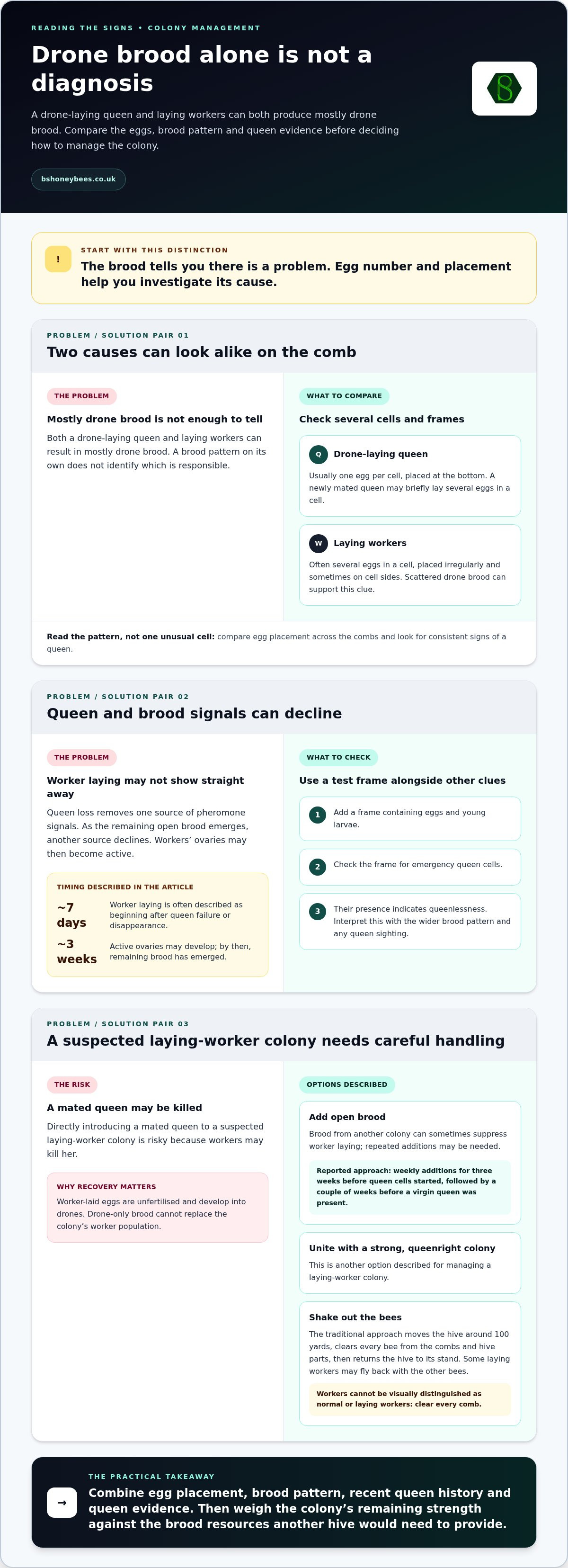
Drone brood alone doesn’t tell you whether the cause is a drone-laying queen or laying workers. Egg placement is a stronger clue: a drone-laying queen usually lays one egg per cell, while laying workers often leave several eggs in irregular positions, sometimes on cell sides.
It’s easy to mistake one problem for the other, especially after a colony loses or replaces its queen. Both can result in mostly drone brood, but the cause matters because the colony’s prospects and the right response differ. This guide explains how to read the signs, why workers may begin laying when queen and brood signals decline, and how to reduce the risk after swarming, splitting or supersedure. You’ll also learn why worker-laid eggs produce drones and why that can leave a colony unable to replace its workforce.
Key Takeaways
- Use egg number and placement alongside the brood pattern to help identify whether the colony has a failing queen or laying workers.
- Consider recent queen loss and the availability of open brood: declining pheromone signals can allow workers’ ovaries to develop.
- After swarming, splitting or supersedure, keep track of the colony’s queen status while a replacement queen develops and begins laying.
- Worker-laid eggs are unfertilised and develop into drones, so they cannot rebuild the colony’s worker population.
- Learn which recovery options may suit a laying-worker colony, and when a queen or nucleus colony may be relevant to your next steps.
Do you have a drone-laying queen or laying workers?
Drone brood alone doesn’t show whether one queen or several workers are laying. Compare the eggs, brood pattern and evidence of a queen before choosing how to manage the colony.
Causes of worker laying
Worker laying occurs when worker ovaries become active as queen and open-brood pheromone signals decline. Queen loss removes one source of these signals, while emerging brood gradually reduces another. This matters after a failed queen or unnoticed queen loss, because changes in the brood can leave the colony vulnerable to worker laying.
Workers may develop active ovaries after about three weeks without a queen, once the remaining brood has emerged. This delay can make the change difficult to recognise: a colony may be queenless before worker-laid eggs become visible. Drone brood then develops, but it cannot replace the workers needed to maintain the colony.
Confirming queen status
A test frame helps establish whether the colony recognises that it has no queen. Add a frame containing eggs and young larvae, then check for emergency queen cells. Their presence indicates queenlessness. Interpret this alongside the brood and any queen sighting, since no single clue may explain the colony’s condition.
Check several cells and frames for multiple eggs, irregular placement or eggs on cell sides. These signs can indicate laying workers, particularly when drone brood appears in a scattered pattern. A drone-laying queen usually lays one egg per cell, although a newly mated queen may briefly lay several. Workers may also lay in a queenright colony, but other workers usually remove those eggs.
To assess a drone-laying queen vs laying worker, combine the test-frame result with the wider brood pattern. Don’t rely on one unusual cell: compare egg placement across the combs and look for consistent signs of a queen.
Managing a laying-worker colony
Directly introducing a mated queen to a suspected laying-worker colony is risky because workers may kill her. Adding open brood from another colony can sometimes suppress worker laying, but repeated additions may be needed. In one reported approach, weekly brood additions continued for three weeks before queen cells started, followed by a couple of weeks before a virgin queen was present.
Other options include uniting the colony with a strong, queenright colony or shaking out the bees. The traditional shake-out involves moving the hive around a hundred yards, clearing every bee from the combs and hive parts, then returning the hive to its stand. Workers cannot be visually distinguished as normal or laying workers, so clear every comb. Some laying workers may fly back with the other bees.
A drone-laying queen vs laying worker diagnosis also affects whether the colony can rebuild. Drone-only brood cannot replace workers, so weigh the colony’s remaining strength against the brood resources another hive would need to provide.
How queen loss and lack of open brood contribute to worker laying
Queen loss and dwindling open brood remove signals that normally restrain workers’ ovaries. The change can be difficult to spot at first, so consider egg placement and brood pattern alongside the colony’s recent history.
Queen loss and worker laying
Worker laying is the activation of worker ovaries as queen and open-brood pheromone signals decline. Queen and brood pheromones help suppress ovarian development, so their absence changes the colony’s reproductive balance. This matters after a swarm, failed queen or unnoticed queen loss, when workers may begin laying before the beekeeper sees a clear change in colony behaviour.
Timing can vary: worker laying is often described as beginning about seven days after queen failure or disappearance, while active ovaries may develop after about three weeks without a queen. By the end of about three weeks, the remaining brood has emerged, removing the brood pheromone source as well. This helps explain why a queenless colony may initially look quiet, then show scattered eggs and drone brood.
A swarm creates a different shift in signals. Queen mandibular pheromone levels fall, but eggs and open brood may remain. Rebel workers can develop in this situation, showing that queen loss alone does not explain every case of worker laying. The amount of remaining open brood also affects the pheromone signals reaching workers.
Egg placement and brood patterns
Egg placement and brood distribution across combs help distinguish worker laying from normal queen activity. Check several cells and frames rather than relying on one unusual patch. Laying workers may place eggs on cell sides, while a queen usually deposits eggs at cell bottoms. Multiple eggs in one cell and scattered placement strengthen the case for worker laying.
Check the capped brood too. Drone brood in worker-sized cells, particularly when scattered and capped with bullet-shaped cappings, may indicate laying workers or a failing queen. A random pattern with empty cells among capped brood can develop when workers remove some eggs. These signs point to a problem, but the brood pattern alone does not identify its cause.
Context helps you interpret the comb. For example, a colony that recently lost its queen and now shows side-laid eggs across several patches is more concerning than one cell containing multiple eggs. A newly mated queen may also lay several eggs in a cell as she starts laying. Compare placement, consistency and brood type before deciding which explanation fits best.
Open brood and worker-sized cells
Adding open brood from another colony introduces brood pheromone that may help suppress worker laying. This can be a management option when worker eggs appear, though repeated additions may be needed. The result depends on the colony’s condition and how long queen and brood signals have been absent. Open brood also gives you a useful point for reassessing egg placement and new brood development.
Worker-sized cells matter because workers can lay unfertilised eggs there, producing drones in cells normally used for worker brood. Inspect the cappings and surrounding pattern: scattered, bullet-shaped drone cappings in worker cells indicate a failing queen or laying workers. Treat this as a reason to investigate further, not proof of the cause.
Once queenlessness is established and requeening is appropriate, F1 Buckfast Queens may be relevant to the next stage of colony management.
How to distinguish laying workers from a drone-laying queen
A drone-laying queen is a queen whose eggs develop as drones rather than workers. Poor mating, damage or running out of sperm can leave her unable to fertilise eggs. The drone-laying queen vs laying worker distinction matters because the eggs may be laid by one queen or by several workers. Start by checking egg placement, brood distribution and whether you can see a queen.
Inspect several cells across more than one comb. A drone-laying queen usually lays one egg per cell, in the usual position at the bottom. Laying workers often leave multiple eggs, sometimes attached to cell sides or placed irregularly. Neither clue proves the diagnosis on its own: a newly mated queen can briefly lay multiple eggs as she starts laying.
Look for the queen, but don’t rely on a brief inspection to settle the question. A queen may be difficult to spot amongst moving bees, and seeing one does not automatically mean she is laying effectively. Observe her on the comb and compare her activity with the fresh eggs nearby. One observed queen remained over a cell for about 10 seconds while apparently trying to lay, illustrating the value of patient observation.
The brood pattern offers another comparison. A drone-laying queen can lay consistently, with one egg per cell, even when all the resulting brood is drones. Laying-worker brood is more likely to appear scattered, with irregular egg placement and multiple eggs in some cells. Drone brood in worker-sized cells can occur in either case, so assess its distribution rather than treating drone brood as a diagnosis.
A failing queen may still be present, which can complicate the distinction. As her condition declines, workers may develop up to around half a dozen active ovarioles; workers have about ten ovarioles in total. This change does not make a worker a queen. Consider whether you see a queen, whether eggs are consistently placed, and whether the brood pattern suggests one laying bee or several.
If queen presence remains uncertain, use a test frame containing eggs and young larvae. Check it for emergency queen cells, which indicate that the colony has no queen. The result adds useful evidence, but interpret it alongside a queen sighting and the existing brood. A drone-laying queen may be present despite drone-only brood, while workers can lay after the queen has disappeared.
To assess a drone-laying queen vs laying worker, record queen sightings, egg numbers and placement, and brood distribution across several combs. A visible queen with one egg per cell points towards a drone-laying queen; multiple, scattered eggs without a queen point towards worker laying. If the clues conflict, compare the test-frame result with the full pattern before deciding how to manage the colony.
Preventing laying workers after swarming, splitting or supersedure
After a swarm, split or supersedure, the colony may temporarily lack a laying queen. Track queen status and brood development rather than assuming that quiet combs mean worker laying has begun.
A virgin queen typically takes 2 - 3 weeks to start laying. During this interval, worker bees may have no new eggs or larvae to care for, especially if the colony has little remaining open brood. Keep the change in queen status in mind when inspecting the colony. A gap in fresh eggs during this period does not, by itself, prove that laying workers have developed.
After swarming, establish whether the colony has a virgin queen, a queen cell or a mated queen. Allow time for a virgin queen to mate and begin laying, then look for fresh eggs and young larvae as signs of progress. If the colony remains queenless, the lack of queen and brood signals can persist. Monitoring is more useful than treating every gap in brood as the same problem.
When splitting a colony, record which portion received the queen, queen cell, eggs and young larvae. This gives you a clear reference during later inspections. If a split has no queen, note when that began and watch for signs of a developing replacement. A test frame with eggs and young larvae can help assess queen status if an inspection leaves doubt.
Supersedure also needs close observation: the old queen may be failing while the colony raises a replacement. Check for the new queen’s presence and subsequent egg-laying before concluding that the colony is queenless. A queen that has not begun laying may still be developing, so distinguish this transition from a colony with multiple eggs and irregular placement.
Queen introduction requires attention to how long the colony has been queenless. Workers can be left queenless for a few hours to a day before introducing a queen cell or another queen, but the suitable interval partly depends on how long they have already been queenless. Don’t treat that window as a universal timetable. The colony’s history and condition affect the introduction.
Use a simple inspection record after each colony change: note the event, queen evidence, eggs, larvae and any queen cells. Compare observations at successive inspections, rather than relying on one frame. If a virgin queen is still within the usual 2 - 3 week period before laying, patience and continued monitoring can help prevent an unnecessary intervention. If queenlessness continues, act before the brood gap allows worker laying to become established.
Drone offspring produced by laying workers
Worker-laid eggs cannot rebuild a colony’s workforce: they are unfertilised and develop into drones. That is the central problem, not simply the presence of drone brood. A colony needs workers to care for brood, maintain comb and carry out other essential tasks. Drones cannot take over those jobs, so each new batch of worker-laid eggs leaves the underlying shortage unresolved.
Consider a queenless colony where workers lay eggs in worker-sized cells. Those eggs can hatch and develop, but they produce drones rather than replacement workers. Even if the brood pattern looks busy, it does not show that the colony is recovering its ability to maintain a worker population. Assess whether the colony has a queen and whether its brood can produce workers, not just whether eggs are present.
This distinction also matters when interpreting drone brood. A drone-laying queen can produce drones because her eggs are unfertilised, while laying workers also produce unfertilised eggs that develop as drones. The brood outcome is similar, but the source differs. Egg placement, the number of eggs per cell and a queen sighting help establish which bees are laying.
Other bees may remove worker-laid eggs, leaving empty cells among capped brood. This can make the developing brood patchy rather than creating a solid area of drone brood. Compare several parts of the comb: scattered eggs and empty cells alongside drone brood indicate a different pattern from a queen laying consistently. The developing drones still cannot replace the workers the colony needs.
Thelytoky is a rare exception to the usual development of worker-laid eggs as males. For practical colony assessment, treat worker-laid eggs as a source of drones, not as a route to raising a queen. An egg laid by a worker cannot produce a queen through normal development because it is unfertilised. A colony that needs a queen must regain one another way.
This reproductive mismatch makes prolonged worker laying costly for the colony. Workers invest in brood that becomes drones, while those offspring cannot expand the workforce. Adding young larvae from another colony may support an attempt at recovery, but it does not change the sex of eggs laid by workers. Judge progress by renewed queenright laying and the development of worker brood.
When drone-only brood has left a colony unable to rebuild, focus on restoring a viable worker population rather than waiting for drones to fill the gap. Depending on the colony’s condition, a beekeeper may consider combining it with a strong queenright colony or establishing a replacement. Explore replacement colony options when the existing colony cannot sustain itself.
BS Honey Bees: F1 Buckfast Queens
BS Honey Bees Ltd supplies F1 Buckfast Queens for beekeepers planning to requeen a colony after identifying its queen status. Carniolan Queens are another queen option, while 5 / 6 Frame Nucs may suit beekeepers establishing a replacement colony rather than relying on a weakened one. The right choice depends on whether the colony can support a queen introduction or needs a fresh start.
For colony management, BS Honey Bees Ltd also offers 2 in 1 Poly Nucs. Consider these options once you’ve assessed the brood pattern and decided on your next step. Contact BS Honey Bees Ltd to discuss its queen and nucleus colony offerings.
Choose the next step that protects colony strength
Carefully distinguishing a drone-laying queen from laying workers helps you choose between managing the existing colony and starting again with a replacement. Before committing brood from another hive, weigh the likely benefit against the resources the donor colony must give up. Recovery is not automatically the best use of healthy brood: the condition and remaining strength of both colonies matter.
Use your inspection findings to make a clear decision, then keep the next action focused. If the colony can be managed, avoid interventions without a clear purpose. If it cannot sustain a worker population, plan for a viable replacement rather than waiting for drone brood to solve the problem. A considered choice can protect the wider apiary as well as the colony you are inspecting.
Contact BS Honey Bees for help with your next beekeeping decision. Take the next step with a clearer plan and renewed confidence.
Frequently Asked Questions
Can a laying worker colony be saved?
Yes, a laying-worker colony can sometimes recover, but success depends on its condition and the intervention used. One beekeeper reported correcting two advanced cases by adding brood with ripe queen cells. This shows that recovery is possible, not assured. Before using brood from another hive, consider whether the donor colony can spare it and whether the affected colony still has enough bees to support a replacement queen.
What to do?
First decide whether the colony is queenless or still has a queen producing drone brood. Record what you see across the combs, including queen cells, eggs and emerging brood, then choose an intervention that fits the diagnosis. Avoid introducing a queen immediately if you suspect laying workers, because they may kill her. For a confirmed laying-worker problem, consider whether brood additions, uniting or shaking out best fits the colony’s condition.
What is a laying-worker colony and why do workers lay eggs?
A laying-worker colony is one where adult unmated worker bees have activated ovaries and are producing eggs. Worker laying can follow queen loss, especially as open brood disappears and its suppressive signals decline. The eggs are unfertilised, so they develop as drones rather than workers. Eggs in the comb therefore don’t necessarily mean the colony can replace its workforce or build a functioning queenright population.
How can you tell a drone-laying queen from laying workers?
Compare the queen’s presence with egg placement across several combs. A queen that lays one egg per cell points towards a drone-laying queen, even if all the brood is drones. Multiple eggs in irregular positions make worker laying more likely, though a newly mated queen can also lay several while starting. A test frame with eggs and young larvae adds evidence: emergency queen cells indicate the colony has no queen.
What do eggs and brood patterns look like with a drone-laying queen versus laying workers?
A drone-laying queen generally places one egg in each cell, while worker-laid eggs are more likely to appear in clusters, on cell sides or in inconsistent positions. Both situations can produce drone brood, including drones raised in worker-sized cells. Look at the wider pattern, not just one cell: other bees may remove worker-laid eggs, leaving gaps among capped brood and making the developing patch look uneven.
How should you manage or requeen a drone-laying queen colony?
Management depends on the season and the queen’s condition. For a drone-laying queen found in spring, shaking out the colony or uniting it with another colony is recommended rather than relying on requeening. In summer, requeening is the suggested option. One approach involves removing queen cells after a week, then adding a frame containing eggs and young larvae. Choose a method only after distinguishing a failing queen from laying workers.
How can you manage a laying-worker colony, and can it be rescued?
Recovery attempts include repeatedly adding open brood, introducing brood with ripe queen cells, uniting with a strong queenright colony or shaking out the bees. A colony receiving a comb of brood each week may take three weeks to start queen cells, followed by a couple of weeks before a virgin queen is present. This timeline helps set expectations; the donor colony’s brood resources and the affected hive’s remaining strength matter too.
What UK beekeeping guidance or seasonal considerations apply to these colonies?
The recommended response to a drone-laying queen depends on the season: spring favours shaking out or uniting, while summer favours requeening. After swarming or queen replacement, allow a virgin queen the usual two to three weeks to start laying. During that interval, track queen status and brood development instead of treating every pause in fresh eggs as worker laying. The colony’s recent history helps distinguish a normal transition from prolonged queenlessness.