The infant warning is only one part of selling honey legally in the UK. For prepacked honey, the label must identify the food, its country of origin, the producer or packer’s name and address, storage conditions, a best-before date, a lot mark and the net weight. Any declarable allergen must also be identified on the label.
It’s easy to assume that plain honey and flavoured honey follow the same labelling approach, but added ingredients can bring allergen declarations into play. A voluntary warning that honey is unsuitable for children under 12 months is also different from a mandatory allergen declaration.
This guide explains how to sell honey legally in the UK, including what to put on the label, how to describe its origin and when small-scale direct sales may qualify for a food business registration exemption. It also covers storage and best-before details, so you can work through the practical requirements before your jars reach customers.
Key Takeaways
- Make the honey’s country of origin clear, and use a regional name only when the honey comes entirely from that place.
- Build your label around the required product details, including metric net weight, a best-before date and a lot mark.
- Plan storage and shelf-life information carefully; UK Government sets honey’s maximum HMF level at 40 milligrams per kilogram.
- Small-scale direct sales may qualify for a food business registration exemption, but in Scotland Food Standards Scotland requires honey sellers to register with their local authority at least 28 days before trading.
- For flavoured honey, identify any declarable allergens present and distinguish an allergen declaration from a voluntary warning about infants.
Country of origin labelling
Country-of-origin labelling identifies where the honey was harvested, not simply where it was packed. In Great Britain, the label must name that country or describe the blend if the honey comes from several countries.
Prepacked Honey Label Formats
Prepacked honey is placed in its container before sale. Honey prepacked for direct sale is packed before a customer selects or orders it. For both formats, use a clear food name and state the country or countries of origin. The UK Government says honey from multiple countries may use wording such as “blend of honeys from more than one country”.
For honey sold without prepacking, you must still provide the name and country or countries of origin. The format changes how the product is presented, but not the need to make its identity and source clear. Keep the origin wording clearly connected to the honey being offered, whether it is in a jar or sold as a direct-sale portion.
Producer Details and Country of Origin
On a prepacked label, the producer or packer’s name and address identify the responsible business. The address should provide a physical postal contact, not just a website or email address. It does not replace the origin declaration: a seller’s address in one country does not show where the honey was harvested.
State the origin using a country name. A regional name such as “Edinburgh Honey” is suitable only if all the honey comes from that place. Avoid wording that suggests a source the honey does not have: “packed in Edinburgh” and “harvested in Edinburgh” mean different things.
For imports sold in Great Britain, the origin declaration must identify the country where the honey was harvested. Under Regulation 17(1), UK Government says honey from multiple countries may instead use wording such as “blend of honeys from more than one country”. For Northern Ireland blends, since 14 June 2026, labels must list every country of origin and its percentage.
Honey means a product that meets the prescribed compositional standards, rather than any sweet food made with honey. In England and Wales, the Honey (England) Regulations 2015 and Honey (Wales) Regulations 2015 are relevant to honey labelling; honey sold in England and Wales must meet the prescribed standards to use that name. The Food Information (Wales) Regulations 2014 are also relevant in Wales.
Quality requirements matter alongside origin. UK Government sets honey’s maximum water content at 20%, and its maximum HMF level at 40 milligrams per kilogram. HMF is a quality measure used for honey; the limit applies whether a jar says “English honey” or names another country.
Across Great Britain, apply the same core origin principle: state the country where the honey was harvested, or identify it as a blend from multiple countries. The seller’s address and place of packing do not replace this declaration. Keep descriptions precise, especially when a label names a country, region or floral source.
Best-before dates and storage conditions
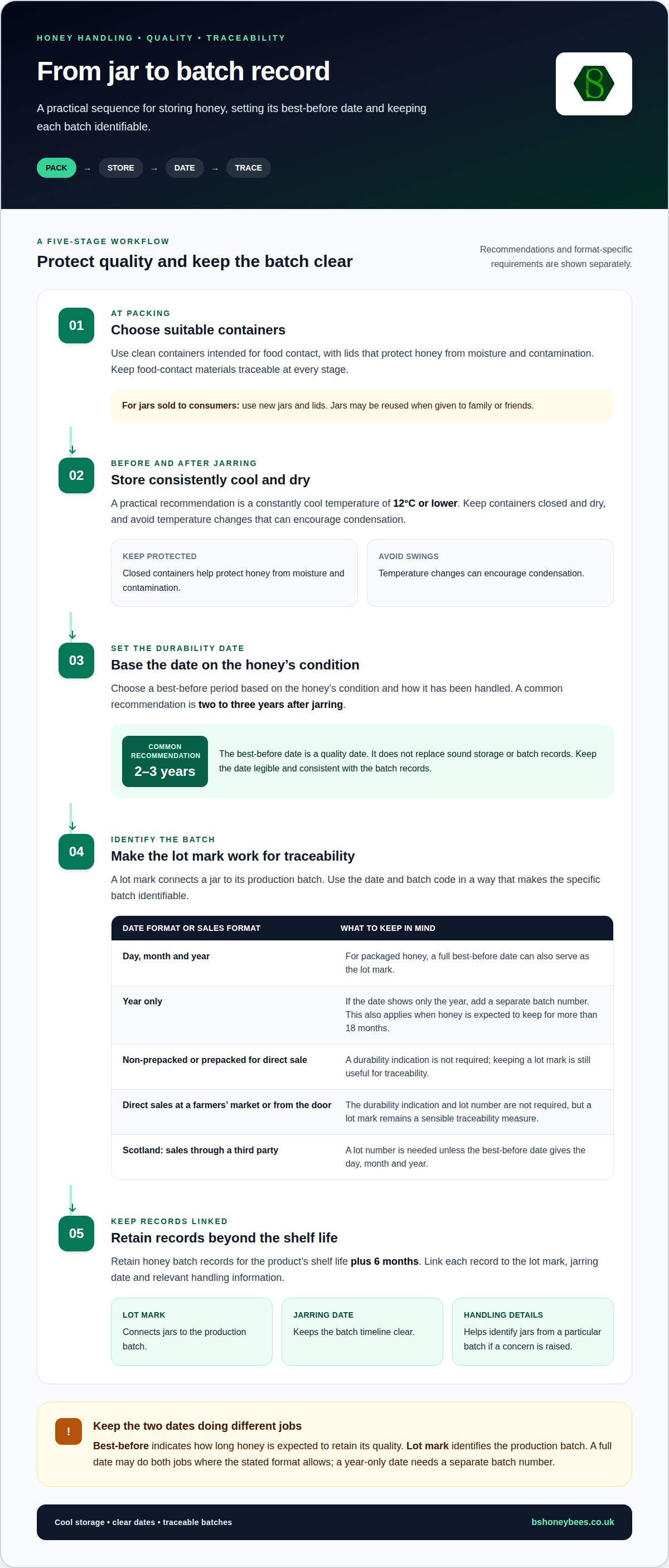
A best-before date indicates how long honey is expected to retain its quality, while a lot mark identifies its production batch. Store honey in clean, food-contact packaging in a consistently cool place, and keep batch records linked to each jar’s date and lot mark.
Best-Before Dates and Lot Numbers
A lot mark is a code that connects a jar to its production batch. For packaged honey, a best-before date can also serve as the lot mark if it includes the day, month and year. If the label gives only the year, add a separate batch number so the specific batch remains identifiable.
Honey expected to keep for more than 18 months may carry a best-before date showing the year alone, but that format needs a separate lot mark. For non-prepacked honey and honey prepacked for direct sale, a durability indication isn’t required; keeping a lot mark is still useful for traceability. In Scotland, honey sold through a third party needs a lot number unless its best-before date gives the day, month and year.
Honey Storage and Packing
Honey storage means keeping the product in conditions that protect its quality before and after jarring. A practical recommendation is a constantly cool temperature of 12°C or lower. Keep containers closed and dry, and avoid temperature changes that can encourage condensation.
Use containers intended for food contact, with lids that protect the honey from moisture and contamination. Keep materials that contact food traceable at every stage. Jars given to family or friends may be reused, but use new jars and lids for honey sold to consumers.
Choose a best-before period based on the honey’s condition and how it has been handled. A common recommendation is to set the date two to three years after jarring. This is a quality date, not a substitute for sound storage or batch records. Keep it legible and make sure it matches the records for that batch.
Retain honey batch records for the product’s shelf life plus 6 months. Link each record to the lot mark, jarring date and relevant handling information. If a customer raises a concern, these details help identify which jars came from the particular batch rather than treating all stock as identical.
For direct sales at a farmers’ market or from the door, the durability indication and lot number aren’t required, but a lot mark remains a sensible traceability measure. For other packaged sales, make sure the best-before date and batch code are clear and consistent. Requirements can differ by sales format, so keep your records and presentation aligned.
If you’re planning to sell English honey, the same careful approach to storage and batch identification helps protect each jar’s quality. Explore English honey as a product option.
Food business registration exemptions for small, local honey sales
A registration exemption removes a specific food-hygiene registration requirement; it doesn’t remove the need for accurate food information or hygienic handling. Whether an exemption applies depends on the supply arrangement, not simply on calling honey homemade.
You can sell honey from home, at a market, online or through a farm shop, subject to the rules that apply to your business and sales. In Great Britain, the registration exemption covers a producer’s direct supply of small quantities of primary products to final consumers, or to local retail establishments that supply consumers directly.
When small-scale registration exemptions may apply
Article 1(2)(c) provides the relevant exemption for that direct supply. The legislation gives no specific small-quantity threshold for honey, so don’t assume that a particular number of jars automatically qualifies. Selling through a local shop may fit only where that retailer supplies consumers directly; the exemption doesn’t cover every wholesale arrangement.
Food business registration is free. In Scotland, however, Food Standards Scotland says anyone selling honey must register as a food business with their local authority at least 28 days before trading. This requirement applies even when sales are small or local. Keep the registration question separate from the sales channel: a market stall, online order or home collection doesn’t itself determine whether an exemption applies.
Hygiene, premises and food-contact containers
Food hygiene registration concerns the food business and its activities, not a licence to keep bees. No licence is required to keep bees in the UK, but that does not determine whether a honey-selling business needs registration. Keep extraction and packing areas clean, protect open honey from contamination, and organise handling so each stage remains hygienic.
Food-contact suitability means the jar and lid are appropriate for contact with food. Use containers marked as suitable for food contact or bearing the cup-and-fork symbol. Retained Regulation (EC) No 1935/2004 is relevant to materials that contact food. New jars and lids are advised for honey sold to consumers; reusing jars for family or friends is a different situation.
Clear claims and other obligations
Food information must be accurate, clear and easy for consumers to understand. Describe floral or regional character only when the honey meets the relevant conditions. For example, a floral-source name is appropriate only when the honey comes wholly or mainly from that blossom. Trading Standards supports a voluntary warning that honey is unsuitable for children under 12 months.
No licence is required to keep bees, and product liability insurance is separate from food-business registration. The rules covered here require accurate food information, but don’t set out a single penalty amount for misleading labels. Avoid unsupported claims, use precise descriptions and keep your sales information consistent with the honey you supply.
What must be on a honey label?
A honey label gives consumers the product’s identity, quantity and key handling information. For prepacked honey, organise the required details clearly, then make the net weight easy to find and read. Knowing how to sell honey legally in the UK starts with a label that accurately describes the jar.
Net Weight Declarations
Net weight is the quantity of honey in the jar, excluding its container and lid. State it in metric units, using grams or kilograms, such as “340 g”. An imperial measure may also appear, but it must be no more prominent than the metric declaration. Individual honey portions below 5 g are exempt from a net quantity indication.
Metric net weight helps consumers compare like with like, whilst an optional imperial equivalent may aid familiarity. For example, “454 g (1 lb)” places the metric figure first and keeps the imperial measure secondary. The weight must describe honey alone, not the combined weight of glass and lid.
Keep the food name and net quantity together in the same field of vision, as required by Article 13(5). For common jar sizes such as 227 g, 340 g and 454 g, the weight numerals must be at least 4 mm high. That makes the quantity legible without forcing the consumer to turn the jar around.
Lot and Weight Marking
A lot mark identifies the batch a jar belongs to, while the weight marking states the amount of honey inside. Keep the declarations distinct: one supports traceability, the other tells consumers the net quantity. A full best-before date can also serve as a lot mark if it includes the day, month and year.
If the best-before date gives only the year, add a separate batch number. This lets you connect a particular jar with its production records, rather than relying on the weight declaration to identify the batch. Place the lot mark where it remains readable on the finished pack.
A prepacked honey label also needs the food name, producer or packer’s name and address, country of origin, storage conditions, best-before date, lot mark and net weight. Keep the food name and weight visible together, and ensure mandatory particulars generally have an x-height of at least 1.2 mm. If the package’s largest surface is under 80 square centimetres, the minimum is 0.9 mm.
Raw honey, as an unprocessed single-ingredient food, is exempt from a nutrition declaration. Filtered honey must instead declare energy, fat, saturates, carbohydrate, sugars, protein and salt. Honey finely filtered to remove significant pollen must be described as “filtered honey”, not simply “honey”.
Use suitable weighing equipment to fill and check jars. Trade-approved instruments carry an M marking, the letter M and year inside a rectangle, beside the CE or UKCA conformity mark. If you’re learning how to sell honey legally in the UK, consistent weighing helps ensure the printed metric quantity matches the honey packed.
Flavoured honey and allergen declarations
Flavoured honey combines honey with another ingredient to create a distinct product. The key is to describe the contents accurately and declare any relevant allergens, rather than relying on a general honey label.
Start with the product’s composition. In England and Wales, a product may be called honey only if it meets the prescribed compositional standards. If you add an ingredient, make the product description clear about it. Don’t present a flavoured or otherwise altered product as though the jar contains unmodified honey alone.
An allergen declaration tells consumers when a food contains a regulated allergen. For prepacked-for-direct-sale food, the label must identify any of the 14 declarable allergens present. This includes flavoured honey sold in a container packed before the customer selects or orders it. The declaration is tied to the ingredients actually used, not merely to the product’s name.
Use a simple process for each recipe or batch. Record every ingredient, then establish whether any contains a declarable allergen. If so, identify it clearly in the relevant food information. Keep recipe details and product labelling aligned when an ingredient changes: a revised recipe can change the allergen information consumers need.
Allergen information and an infant warning serve different purposes. A voluntary warning supported by Trading Standards says honey is unsuitable for children under 12 months. That warning concerns honey and infant safety; it does not identify allergens in a flavoured product. One statement cannot replace the other when an allergen is present.
Keep descriptions specific and consistent on the jar and in any sales information. Name the added ingredient rather than using a vague phrase such as “with flavour”. Clear, accurate food information helps consumers understand what they’re buying and prevents a description from implying a composition the jar does not have.
Don’t confuse an ingredient’s presence with a nutrition declaration. Raw honey, as an unprocessed single-ingredient food, is exempt from a nutrition declaration. Filtered honey has separate nutrition declaration requirements; adding an ingredient makes accurate product information especially important. Check each product’s format and composition before preparing its label.
For selling flavoured honey, treat each recipe as its own labelling decision. Keep the ingredient information, allergen declaration and product name consistent from preparation through sale. If you’re choosing honey without added ingredients, explore English honey.
BS Honey Bees
BS Honey Bees is a natural next step when you’re building or managing an apiary alongside your honey-selling plans. Its beekeeping products include F1 Buckfast Queens, Carniolan Queens, 5 / 6 Frame Nucs and 2 in 1 Poly Nucs. These options support different apiary needs, from introducing a queen to establishing a nucleus colony.
Choose equipment or a colony type that fits your plans, while handling labelling, hygiene and registration requirements separately. The right beekeeping setup can support honey production, but it doesn’t replace accurate product information or any required food-business registration.
For beekeeping products to support your plans, contact BS Honey Bees.
Build a confident honey-selling routine
Build compliance into each production run instead of leaving it until the final label check. Set a clear point in your workflow to review the product description, recipe changes and packaging before offering a batch for sale. This makes it easier to keep decisions aligned as your honey range develops.
A practical plan for how to sell honey legally in the UK should also account for the business side: decide which products to offer, how to present them and what your next apiary priorities are. Make these choices deliberately so each new batch fits your plans and can be prepared with care.
If you’re developing your apiary alongside your honey plans, take the next step at a pace that suits you. Discuss your plans with BS Honey Bees and move forward with clarity.
Frequently Asked Questions
What about the infant warning?
A warning that honey is unsuitable for children under 12 months is voluntary, not an allergen declaration. Trading Standards supports this wording as a useful safety message for consumers. If you sell a flavoured honey containing a declarable allergen, the warning doesn’t replace the allergen information. Treat the two statements separately: one relates to infants, whilst the other tells customers about allergens in the product.
Do I need to register as a food business to sell honey in the UK?
Not every small, local honey sale requires food business registration in Great Britain. An exemption may apply when a producer supplies small quantities of primary products directly to consumers, or to local retailers that sell directly to consumers. There’s no specific honey quantity threshold in the relevant English food hygiene regulations. The selling arrangement matters: direct sales and supplying a retailer for onward sales to consumers aren’t automatically treated the same way.
How do I register a honey business with my local authority, and when?
Register with your local authority before trading if registration applies to your honey business. In Scotland, Food Standards Scotland requires anyone selling honey to register at least 28 days before trading. Build that lead time into your launch plans rather than waiting until the first market or online order. Food business registration is free. Registration requirements can depend on your location and supply arrangement, including whether you sell directly or through a retailer.
What UK hygiene and food safety rules apply to producing and selling honey?
Handle honey hygienically, use food-contact containers and keep records that link batches to the products you sell. For example, record which batch went into each group of jars so you can trace the honey from extraction through packing. Honey must also meet the compositional standards for its product name. These controls support safe handling and reliable product information, but a clean workspace is no substitute for compliant labelling.
What must honey labels include under UK food labelling rules?
For prepacked honey, provide the product name, producer or packer’s name and address, country of origin, storage conditions, best-before date, lot mark and net weight. Make the metric weight clear, and don’t let an imperial equivalent dominate it. A flavoured product also needs accurate ingredient information, including any declarable allergens. For instance, identify an allergen in a jar that contains one; the infant warning does not meet that requirement.