A sugar roll can return bees alive to the colony, but its result depends on how carefully the sample is collected and handled. To learn how to check for varroa mites using a sugar roll, take a sample of 200 or 300 bees, coat them with icing sugar, then shake the mites through a mesh for counting. The method offers a non-lethal alternative to an alcohol wash, but powdered sugar can underestimate mite levels, particularly when mite loads are higher.
That trade-off matters: a test is useful only when you understand what its result can and can’t tell you. This guide compares sugar-roll instructions, explains how the method affects bee welfare and accuracy, and shows how it differs from an alcohol wash. You’ll also find practical equipment and sampling guidance to help make results more consistent and clarify the method’s strengths and limits.
Key Takeaways
- Use a consistent sample of 200 or 300 bees and follow one complete sugar-roll procedure, as instructions differ in coating and resting times.
- Keep the queen out of the sample and take bees from brood comb when possible to make the mite count more informative.
- Treat a sugar-roll result as an estimate: powdered sugar can clump in humid conditions, and the method may underestimate heavier mite loads.
- Choose between a sugar roll and an alcohol wash by weighing the value of returning bees alive against the need for a more precise count.
- Use the right jar, mesh and icing sugar, then record the result so you can compare monitoring checks over time.
Differences between sugar-roll instructions
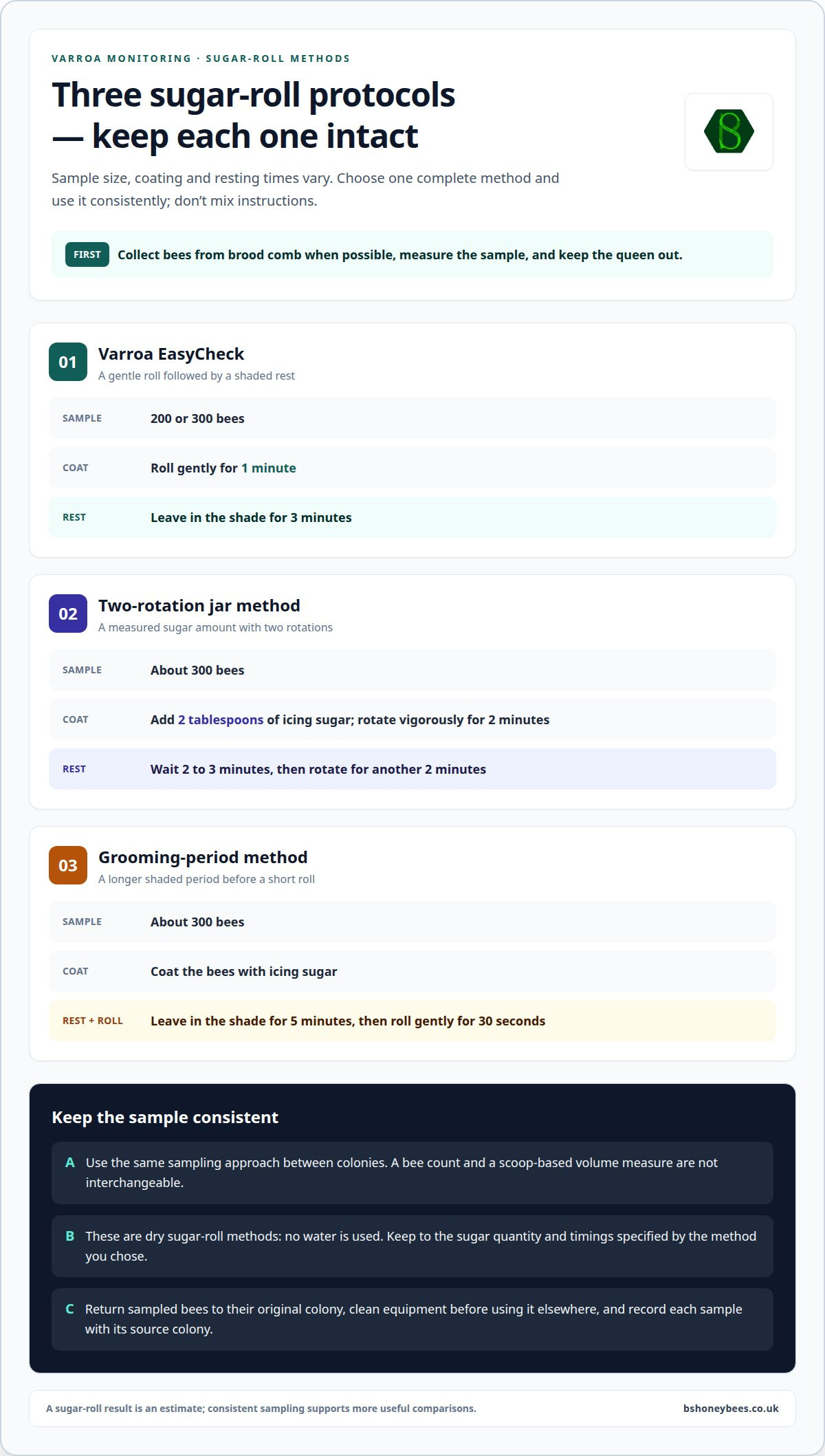
Sugar-roll protocols vary in sample size, coating time and resting period, so follow one method from start to finish. The guidance below compares two approaches and explains how to keep sampling consistent between colonies.
Bee sample size
Use 200 or 300 bees for the Varroa EasyCheck method; other sugar-shake instructions describe about 300 bees, or half a cup. A frame of capped brood is the preferred source because it provides access to nurse bees. Shake bees from brood comb into a container, then measure the sample and make sure the queen isn’t included.
Icing sugar and water amounts
One protocol uses 2 tablespoons of icing sugar, while the Varroa EasyCheck instructions specify coating bees with powdered or icing sugar without that measure. These are dry sugar-roll methods: no water is used. Don’t combine sugar quantities or timings from different protocols, as that changes the procedure you’re following.
Here is how the instruction sets compare:
| Method | Sample | Sugar and coating | Rest and final step |
|---|---|---|---|
| Varroa EasyCheck | 200 or 300 bees | Roll gently for 1 minute | Leave in shade for 3 minutes |
| Two-rotation jar method | About 300 bees | Add 2 tablespoons icing sugar; rotate vigorously for 2 minutes | Wait 2 to 3 minutes, rotate another 2 minutes |
| Grooming-period method | About 300 bees | Coat with icing sugar | Leave in shade for 5 minutes, then roll gently for 30 seconds |
Choose one complete protocol and use it consistently. Don’t mix timings from different methods.
For a practical sequence, the sample is collected from brood comb, kept free of the queen, and processed using the chosen method. In the EasyCheck approach, the sample is rolled for 1 minute and left in the shade for 3 minutes. In the two-rotation method, the jar is turned for 2 minutes, rested for 2 to 3 minutes, then turned for 2 minutes again. Keep sugar from passing through the white basket’s holes during rolling.
To reduce the risk of carrying mites between apiaries, return sampled bees to their original colony and clean your equipment before using it elsewhere. Keep each sample linked to its source colony, and don’t move bees or sugar-coated samples between sites. In the UK, Varroa mite is a reportable pest, according to the UK Government, so keep accurate colony records.
Researchers used a ½ cup scoop of bees for each sugar-roll sample. This is another way to describe the sample amount alongside protocols that specify a bee count. Scoop-based and count-based measures aren’t interchangeable, so record which one you use and don’t switch partway through a series. The distinction matters when comparing results: different sample sizes can make results less consistent, even when you follow the same rolling and resting steps.
If your protocol uses a volume measure, collect the same stated amount for each sample and link it to its source colony. If it specifies a bee count, follow that count rather than estimating a volume. Either way, use the same sampling approach across colonies. Don’t combine a scoop measure with another method’s instructions or change the rest of the procedure.
Sugar-roll accuracy and mite underestimation
A sugar-roll count is an estimate, not a complete measure of every Varroa mite in a colony. In one study, researchers processed 36,754 bees across 124 sugar rolls and counted 1,107 mites. All four powdered-sugar methods tested produced statistically equivalent estimates, but the shakes increasingly underestimated mite levels as infestations rose. Six of the 124 tests, or 4.5%, gave an erroneous result against the study’s economic threshold.
Consistency matters especially when a count is close to a treatment decision point. Beekeeper technique and air humidity can also affect sugar-roll results: humid air may cause icing sugar to clump and reduce mite separation. Record each count with its date and colony, then interpret it alongside the season and brood status. It’s a point-in-time guide, not a guarantee of the colony’s total mite burden.
For a 300-bee sample, divide the mite count by 3 to estimate the percentage when no brood is present. With brood present, divide by 3 and double the result to account for mites in sealed brood. For example, 15 mites gives 5% without brood; 18 mites gives an estimated 12% when brood is present.
- At least 1% in early spring: treatment is indicated.
- Above 2% between honey flows: treatment is indicated.
- Above 3% in July-August, before treatment: treatment is indicated.
- At least 2% in winter, after end-of-season treatment: treatment is indicated.
These seasonal thresholds help put a count into context. For example, a 5% estimate has different implications depending on whether the sample was taken in early spring or after the main season. Keep the calculation and sampling date together in the colony record.
Test colonies at least 4 times a year to monitor mite infestation properly. Checks across the season can show whether counts are rising or falling, while one isolated result cannot show that trend. Use the same calculation basis when comparing records, especially when brood is present.
Varroa mites are reddish-brown, about 1.1 millimetres long and 1.7 millimetres broad. After a sugar roll, mites that pass through the mesh can be counted as they float on water. In the UK, varroa mite is a reportable pest, according to the UK Government. Treat a suspected sighting as a reporting matter, not simply as a routine count to file away.
Sugar shakes or rolls are thought to be more accurate than monitoring natural mite drop on insert boards. Add each point-in-time result to the colony’s hive record.
Comparing sugar rolls with alcohol washes
Both methods estimate the proportion of sampled bees carrying Varroa mites, but they differ in how mites are dislodged and what happens to the sample. A sugar roll uses powdered sugar and can return the bees alive to their colony. An alcohol wash uses an alcohol solution to separate mites from bees, so the bees cannot be returned alive by that method.
Accuracy depends on the procedure. In a validation test of a double-strainer, double-tub alcohol wash, researchers tested 10,952 bees. They found no mites still attached to the bees and four detached mites, with a reported error rate of 0.04%. That figure applies to the validated method, not every alcohol-wash setup.
The validation used a 91% isopropyl alcohol solution and agitated bee samples for no less than one minute. This controlled agitation helps dislodge mites before they pass through the strainer. Changing the equipment or shortening the agitation changes the procedure, so don’t assume the reported error rate applies to a different setup.
The USDA sugar-shake method collected mites more efficiently per minute than the other methods tested. That measures collection efficiency, not whether every sugar roll gives a more accurate infestation estimate. Powdered-sugar methods can underestimate mite levels, particularly when mite loads are higher, so interpret a low count carefully.
| Criterion | Sugar roll | Alcohol wash |
|---|---|---|
| How mites are dislodged | Powdered sugar encourages mites to separate from bees | Agitation in alcohol detaches mites |
| Sample outcome | Bees can be returned alive to the colony | Bees are immersed in alcohol solution |
| Evidence highlighted here | USDA sugar-shake method collected mites efficiently per minute | Validated double-strainer, double-tub method reported 0.04% error |
| Main caution | Counts may underestimate heavier mite loads | The reported validation applies to its tested method |
Choose a sugar roll if returning sampled bees alive is a priority and you can follow a consistent protocol. Choose an alcohol wash if a validated, precise count is the priority and you accept that the sample is immersed in alcohol. Neither method counts every mite in the colony.
For a fair comparison over time, use the same method in a colony’s records. Sugar-roll and alcohol-wash counts use different separation procedures, so differences may reflect the test as well as changing mite levels. Record the method beside each result, then interpret the count in context instead of treating unlike samples as identical.
How powdered sugar dislodges Varroa mites
Powdered sugar works through contact and movement. Fine particles coat the bees and mites as you roll the sample, then the bees groom themselves during the resting period. Their movement helps loosen mites from their bodies. The mesh separates the sample: sugar and detached mites pass through, while the bees stay inside.
Treat the process as a sequence, not a single shake. Sugar needs to coat the bee sample, and the resting period gives bees time to groom. If you’re learning how to check for Varroa mites using a sugar roll, focus on even coverage and follow the full timing in your chosen method. A light dusting or too little movement may leave more mites attached.
After mites fall through, they can be counted as they float on water. Water helps make the small reddish-brown mites easier to distinguish from loose sugar and debris. Varroa mites measure 1.1 millimetres long and 1.7 millimetres broad, so inspect the collected material carefully rather than relying on a quick glance.
For consistent results, follow the same sequence each time:
- Place the bee sample in the shaker or jar, keeping the queen out.
- Add the icing sugar required by the chosen method and coat the bees evenly.
- Roll or rotate the container as directed, allowing bees to groom during the specified rest.
- Shake and tap the container so sugar and detached mites fall through the mesh.
- Use water to reveal mites in the collected sugar, then count them.
The mesh separates the sample, it isn’t just a lid. While rolling, keep sugar from escaping through the white basket’s holes. Later, gentle shaking and tapping lets icing sugar fall through the mesh lid. If sugar escapes too soon, it may not coat the bees properly. If the mesh is blocked, mites can remain trapped with them.
Powdered sugar can clump in hot, humid weather, making it harder to spread through the sample and dislodge mites, particularly when infestation is heavier. Treat a low count as an estimate from the sampled bees, not proof that no mites remain elsewhere in the colony.
Knowing how to check for Varroa mites using a sugar roll means understanding how each step helps separate mites. Even coating, the movement specified by your method, grooming time and unobstructed mesh all matter. Skipping a step may mean fewer mites reach the counting surface. The test counts mites dislodged from that sample, so careful technique is essential when interpreting the result.
What equipment is needed for a sugar roll varroa mite test?
A sugar roll requires a bee sample, icing sugar and a container that separates mites from bees. The jar or shaker needs to hold the sample securely while letting sugar and mites pass through its mesh. Choose equipment to suit your method: a lid that blocks the mesh can stop mites from falling through.
For the jar, recommended capacities are 500 grams or, for another option, 750 grams. The lid should have 50 to 70 holes, each approximately 3 to 4 millimetres wide. Those openings let icing sugar and detached mites pass through while retaining bees. A shaker’s black line corresponds to 100 ml, providing a reference for measuring the sample in that type of equipment.
Prepare the following before collecting bees:
- A jar or shaker with a mesh lid, using the capacity and design suited to its method.
- Icing sugar, with one sugar-shake jar containing a heaped tablespoon.
- A white basket, if the chosen setup uses one, with holes that retain sugar during rolling.
- A tray or container of water for spotting mites that pass through the mesh.
- A clear space where the sample can be handled and mites counted.
Equipment designs vary, so don’t mix measurements from different setups. A jar with 50 to 70 holes of 3 to 4 millimetres is one specified design; a shaker marked at 100 ml uses its own measurement reference. Likewise, one method calls for a heaped tablespoon of icing sugar, while another protocol uses 2 tablespoons. Follow the quantity that belongs to your chosen method.
After coating the bees, the container must let sugar and mites fall through without losing the sample. Gently shake and tap it for about 1 minute to move icing sugar through the mesh lid. Mites can then be counted as they float on water. A clear surface and good light help distinguish small reddish-brown mites from sugar and other debris.
Set out clean equipment before starting. A sugar shake or roll takes 10 minutes to complete, so collecting the jar, sugar, water and counting surface beforehand keeps the process orderly. In hot, humid weather, powdered sugar is more prone to clumping; check that it remains loose enough to pass through the mesh during the test.
For a ready-to-use apiary setup, browse beekeeping equipment and select kit suited to your chosen monitoring method.
BS Honey Bees
BS Honey Bees Ltd is a practical next step when monitoring results prompt you to review your apiary plans or colony needs. A sugar-roll test helps you assess mite levels; it doesn’t replace sound colony management or treatment decisions. If your plans involve establishing or replenishing colonies, BS Honey Bees Ltd offers F1 Buckfast Queens, Carniolan Queens and 5 / 6 Frame Nucs.
Choose bee stock to suit your apiary plans, and use monitoring results as part of your ongoing colony records. A nuc may help when you’re building colony numbers, while a queen may suit plans to replace a queen. BS Honey Bees Ltd supplies both, supporting beekeeping decisions rather than providing a Varroa test or pest-control service.
For a suitable next step after monitoring, contact BS Honey Bees Ltd to discuss its bee stock.
Make your next monitoring decision count
Use your next colony check to build a consistent record, not just capture a single reading. Note the method and conditions alongside each result, then use the record to guide your next monitoring decision. A repeatable routine makes changes easier to spot and helps you decide when closer attention is needed.
If you’re refining how to check for Varroa mites using a sugar roll, choose a protocol you can apply consistently across your colonies. Focus on careful sampling and meaningful comparisons over time. This gives each test a clear purpose within your wider apiary plans.
When monitoring results lead you to review your colony plans, take the next step with a conversation tailored to your needs. Contact BS Honey Bees to discuss what you’re planning for your apiary. A clear monitoring routine is a practical foundation for confident decisions ahead.
Frequently Asked Questions
How do you count mites after shaking the sugar roll sample?
Count the mites that passed through the mesh, using water to separate them from icing sugar and debris. Look for reddish-brown, oval mites and examine the collected material carefully rather than estimating at a glance. Record the total alongside the colony and test date. This makes later checks easier to compare when you use the same method and sample size.
What varroa mite count or percentage is considered high in the UK?
An infestation rate of 8-12% or higher is considered high. There isn’t one raw mite count that means the same thing for every test: the percentage depends on how many bees were sampled and whether brood was present. For example, 24 mites from 300 bees equates to 8% when brood is absent. Interpret the figure alongside the season and the colony’s monitoring records.
How accurate is a sugar roll compared with an alcohol wash?
A sugar roll can underestimate mite levels, particularly as infestations increase, so it shouldn’t be treated as equally precise in every situation. A validation study of a specific double-strainer, double-tub alcohol-wash method reported an error rate of 0.04%. That result applies to the tested procedure, not every wash. The practical choice involves balancing a live bee sample against the need for a precise count.
What are the risks or common mistakes when doing a sugar roll test?
Common mistakes include uneven sugar coverage, switching between protocols and using powdered sugar that has clumped in humid conditions. These can leave mites attached to bees and produce an artificially low count. Keep the queen out of the sample, use the correct mesh and complete the chosen method in order. A sugar roll measures mites dislodged from sampled bees, not every mite in the colony.