Four hives don’t automatically mean four times the honey you can jar: a typical UK hive may leave around 25 lb of surplus after its own needs are accounted for. So, if you’re wondering how much honey one hive can produce in the UK, that’s a useful starting point, not a fixed annual result.
It’s natural to expect a strong colony to fill several supers, but the harvestable surplus is what remains after the bees have enough stores for winter. A productive season can bring more; poor weather, limited forage or a weaker colony can bring less.
This guide explains the difference between total production and surplus, what affects a hive’s yield, and how to assess output across four hives without treating one season as a guarantee. It also explains why a first-year colony is often better judged by its development than by its honey harvest.
Key Takeaways
- Distinguish a hive’s total honey crop from the surplus available to harvest after the colony’s own stores are considered.
- Use local forage and flowering periods to understand why yields can differ between apiary sites, even in the same season.
- Assess colony strength and queen productivity alongside the harvest; swarming can interrupt growth and reduce the foraging workforce.
- Estimate output from four hives individually rather than assuming each will produce the same amount.
- Keep records across seasons to spot which colonies, locations and forage periods deliver the most consistent results.
How much honey can one beehive produce?
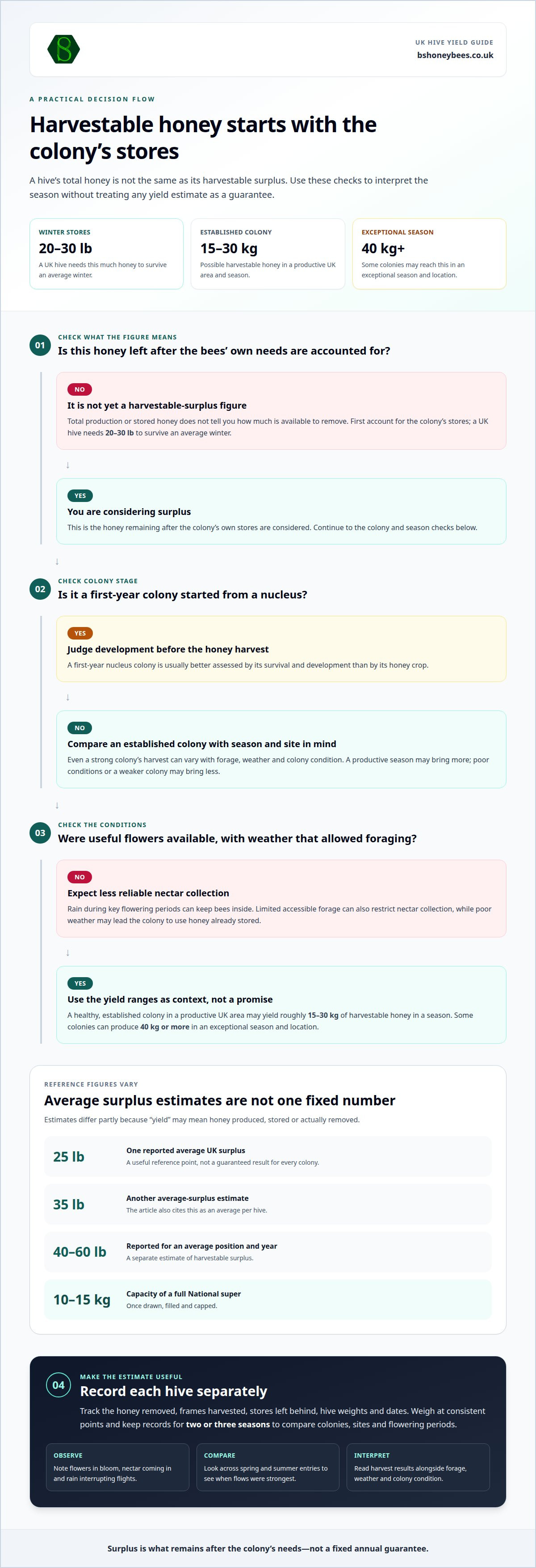
How much honey one hive can produce in the UK depends on the colony, forage and season. The key figure is the surplus: honey left after the bees’ own stores are accounted for.
UK seasonal and annual honey yields
A healthy, established colony in a productive UK area may yield roughly 15-30 kg of harvestable honey in a season. Some colonies can produce 40 kg or more in an exceptional season and location. These ranges help set expectations, but a good season’s total is not the same as the amount available to harvest.
An average UK hive is also reported to produce around 25 lb of surplus, while another estimate for an average position and year is 40-60 pounds of harvestable surplus. A full National super, once drawn, filled and capped, can hold around 10-15 kg. The answer to how much honey one hive can produce in the UK therefore depends on whether you mean total production or surplus.
Leave enough stored honey for the colony: a UK hive needs 20-30 lb to survive an average winter. A first-year colony started from a nucleus is usually judged by its survival and development, rather than its harvest.
Queen replacement can also affect the crop. Natural replacement may leave a hive without a laying queen for approximately three weeks, interrupting brood production while the new queen develops and begins laying.
For honey sold in the UK, moisture content generally must be no more than 20%; heather honey has a higher permitted limit, according to UK legislation. Anyone beginning a food business must normally register with their local authority at least 28 days before trading.
There is no single UK-wide retail price per jar or kilogram. The selling price depends on factors such as jar size and honey type, so harvested weight alone does not determine the retail value.
Starting and maintaining a hive involves equipment and colony costs, followed by ongoing expenses as the apiary is managed. The total depends on the equipment chosen and the hive’s needs over time, so no single figure applies to every beekeeper.
Hive weighing and yield records
Yield records help you track harvests alongside hive weights and dates, distinguishing a strong nectar flow from changes caused by other factors. Record the honey removed from each colony, the frames harvested and the stores left behind. Weighing at consistent points makes comparisons across the season more useful.
Keep records for two or three seasons to identify which sites, colonies and flowering periods produce well for you. Comparing spring and summer entries, for example, can show when flowers provided the strongest flow. Track each hive separately rather than assuming every colony will match the apiary average.
Forage, location and weather
Rain during key flowering periods and a shortage of accessible forage are two major risks to a UK hive’s honey production. Both can limit nectar collection, while poor weather can also make bees use honey already stored in the hive.
Forage means the flowering plants that provide nectar and pollen for a colony. Flowering length and timing vary by location, so two apiaries can experience different nectar flows in the same season. A site with flowers available over a longer period may give bees more chances to forage than one with a short, concentrated bloom.
Weather matters most when useful plants are flowering. Rain during the bloom of a productive crop can keep bees inside and prevent them from collecting nectar. The colony then draws on its stores while waiting for conditions to improve. Rain during the flowering period can therefore reduce the crop more than rain outside it.
Oilseed rape is a clear example of forage where timing matters. Its nectar can contribute to a strong flow, but ripe oilseed rape honey should be removed promptly because it can set hard in the comb. This affects harvest and extraction timing as well as the amount collected. Base decisions on what is flowering at the apiary and how the honey is setting in the frames.
Location shapes the sequence of available flowers. One hive may be near a crop that provides a short, intense flow, while another site has flowering plants across a longer stretch of the season. This helps explain why one average yield cannot describe every UK apiary. The surrounding landscape, crop flowering and local weather all influence how steadily nectar reaches the hive.
Use flowering observations to interpret changes in hive activity. Note which plants are in bloom, whether bees are bringing in nectar, and whether rain interrupts their flights. Then compare those observations with the honey stored in supers. This helps explain why a harvest was strong or modest, rather than attributing every difference to the colony alone.
For a practical comparison, consider two hives during oilseed rape flowering. If one has reliable access to the crop and dry flying weather, while the other faces rain or fewer flowering plants, the nectar they bring in can differ. Forage access and conditions matter even before you account for colony strength.
The most useful way to understand UK honey production is to consider flowers, flying weather and incoming stores together. A productive site cannot overcome rain during the main bloom, and favourable weather cannot compensate for limited forage. Reading these factors together helps explain the harvest without assuming every hive or season will perform alike.
Average surplus honey from a hive
Average surplus means honey harvested after the colony’s needs are accounted for. UK estimates vary: one puts average surplus at 25 lb, while another cites about 35 pounds per hive. These figures are useful reference points, not a guaranteed result for every colony. A reported range of 40 to 60 pounds applies to an average hive in an average position and year.
Yield estimates differ because “yield” can mean honey produced, honey stored or honey actually removed. A colony may store honey that the beekeeper leaves for winter, so total production can exceed the harvest. Surplus is the amount available after the colony’s stores are protected, not simply the weight in the supers.
Individual reports show how widely harvests can vary. One UK beekeeper reported taking 81 pounds from a hive in 2020; another UK beekeeper reported 106 lbs that year. A separate report recorded 142 lbs from one hive in 2018. These examples show what individual colonies have produced, rather than establishing a typical annual expectation.
Higher figures need the same context. Some bee farmers have reportedly harvested 175 lbs per colony for several years, while another reported an average of about 150 lbs per colony. A master beekeeper reportedly considered 30-40 lbs a good result. These reports describe different operations and conditions, so they shouldn’t be treated as directly comparable measures.
For a practical benchmark, compare your hives with the same colonies over several seasons. Keep harvest weight separate from honey left on the hive, and note whether the crop came from summer flows or another flowering period. This makes “average” more useful: it describes your apiary, rather than promising a result based on another beekeeper’s record.
Harvest readiness also affects the amount you can remove. A practical rule is to look for frames with roughly 80 per cent or more of the comb sealed. Capping indicates that the bees have processed the honey, but removing frames too early can leave immature honey. Taking honey as comb rather than spinning it yields less, because the bees must rebuild the cells.
Plan the harvest around the colony’s remaining stores, not a target weight alone. A strong summer flow may fill several supers, but the harvestable surplus is what remains after winter needs are considered. Record the extracted weight and what stayed in the hive to make next season’s comparison clearer.
Colony strength and queen productivity
A strong colony has enough worker bees to raise brood, forage and process nectar at the same time. It can produce two to three times more honey than it needs, whereas a smaller colony must direct more resources towards building its population. This explains why the same flowering period can produce very different harvests from neighbouring hives.
The queen’s laying activity supports that workforce. A steady supply of young bees replaces older foragers and helps the colony use incoming nectar. If brood rearing slows, fewer workers eventually become available to gather and process it. In spring, colony development therefore affects how many bees are ready when later flowers provide a nectar flow.
Swarming can interrupt this build-up. After a swarm leaves, the remaining colony must rebuild its population and may face a shortage of forager bees for up to six weeks. The reduced number of foragers can lower honey yield while the colony recovers. Lost time matters particularly when the interruption overlaps with a strong flowering period.
Colony performance varies between hives, even within one apiary. Some colonies may fill five or six supers, while others produce less. Compare capped frames and the honey brought in during the same forage periods. A large workforce may help a hive use a nectar flow more effectively, but flower availability and flying weather still shape the final crop.
Queen replacement can interrupt brood production. During natural replacement, a hive may be without a laying queen for approximately three weeks. This pause affects the future workforce, rather than instantly removing existing foragers. The effect on harvest depends partly on timing: a gap during a key nectar flow may mean fewer bees are available later.
Winter management influences how much honey can be removed. Leaving a full super for the colony means harvesting 20-30 pounds less than taking all the honey and feeding sugar syrup. This comparison illustrates the trade-off between honey harvest and feeding, not a reason to remove stores without considering the colony’s needs. The aim is to retain a strong colony for the next season.
For useful comparisons, record each hive’s queen status, swarm activity, capped frames and harvested weight. Note whether a colony was recovering from a swarm or replacing its queen when a flow began. A bottom-board check can also help identify signs of a swarm or queen cells during inspection. These details help distinguish a weaker harvest caused by colony development from one linked to forage or weather.
Honey production across four hives
Four hives do not guarantee four equal harvests. In one UK example, four full-size honey-producing hives yielded approximately 51 kg on 26 July 2023. That harvest was around 112 lb and filled more than 200 half-pound jars. The result shows what four newly established hives produced at one site, not a standard for every apiary.
The beekeeper hoped those four hives would eventually produce 300 lb, or 136 kg, each year. That was a target, not the 2023 harvest. Keeping those figures distinct matters: a recorded crop describes what was taken, while an annual aim describes an expected future result.
For four hives, multiplying one colony’s result by four is only a rough planning method. Colonies differ in strength, queen productivity and access to nectar, even in the same apiary. One may fill several supers while another builds more slowly or retains more honey for its own stores. The total harvest is the amount actually removed from each hive, not four times the strongest colony’s crop.
UK beekeeper reports illustrate how apiary totals shift between seasons and colony numbers. One beekeeper reported 184 lb from three to four hives in 2017. Another reported 463 lb from five to six hives in 2018, with about 100 lb left on the hives for winter. The same beekeeper reported 370 lb from six to seven hives in 2019, then 309 lb from five hives in 2020.
These examples make a four-hive estimate difficult without knowing each colony’s condition and stores. Even one beekeeper’s reported total can change between seasons. The 2018 harvest also demonstrates why extracted weight should be recorded separately from honey retained on the colonies. Otherwise, comparing one year’s harvest with another can give a misleading picture of production.
Use a hive-by-hive record to make a more useful forecast for four colonies. For each hive, note the weight removed, the number of frames harvested and what remains for winter. Add the four harvested weights after recording them individually. This preserves the differences between colonies and shows whether a low total came from one hive or a difficult season across the apiary.
The honey’s origin can add useful detail to your records. Where identifiable, note the main flowering source, such as oilseed rape, because forage and harvest timing affect how honey is handled. Across four hives, the combined total helps with planning jars, while individual records reveal which colonies and nectar flows contributed.
BS Honey Bees: British National Hives & Frames
BS Honey Bees supplies British National Hives & Frames for beekeepers planning or equipping an apiary. Hive equipment provides a practical framework for managing colonies and storing honey, while the season’s eventual surplus still depends on colony strength, forage and weather.
If you’re establishing a colony, 5 / 6 Frame Nucs provide a nucleus option, while F1 Buckfast Queens and Carniolan Queens are available for beekeepers selecting queens. These offerings are relevant when planning a new hive or developing an apiary, rather than as a way to guarantee a particular harvest.
Use your yield records and apiary plans to decide which equipment or colony option fits your next step. For enquiries about British National Hives & Frames, queens or nucs, contact BS Honey Bees.
Plan your next season with purpose
Turn this season’s hive records into a practical apiary plan. Note which colonies developed well, where nectar was available and what you want to improve before the next flowering period. This gives you a sound basis for decisions about expanding or replacing colonies, rather than relying on one harvest as your benchmark.
If you’re still considering how much honey one hive can produce in the UK, use records from your own site and colonies to set expectations. Planning cannot control the weather or guarantee a crop, but it can help you make informed choices for the next season.
For your next beekeeping step, get in touch with BS Honey Bees Ltd. Build your apiary with care, learn from each season and keep moving towards your goals.
Frequently Asked Questions
How much honey does a typical UK beehive produce per year?
A useful typical benchmark is around 25 lb of surplus honey from a UK hive in a year. That means honey available to harvest, not the colony’s entire production. The final amount depends on what the bees store and what they need to retain. For a new colony, judge its progress by survival and development as well as any honey collected.
What is the average UK honey yield per hive in a good and poor season?
In a good season, a UK hive can produce 60 lb or more of honey. In a poor season, the harvestable surplus may be very small or absent if bees use their stores during poor flying weather or limited flowering. These are different outcomes, not a fixed good-to-poor range. Record the harvest and remaining stores separately to understand the result.
How many kilograms of honey can a UK hive produce at peak?
In an exceptional season and location, a colony may produce 40 kg or more of honey. That is a peak possibility, not a sensible annual expectation for every hive. The crop also needs to be distinguished from the surplus available to remove. A colony’s own stores remain part of its production, even when they aren’t included in the beekeeper’s harvest.
What factors affect honey production in UK beehives?
Colony strength, queen productivity, swarming, forage and weather all affect the crop. A swarm, for example, can leave a colony rebuilding its workforce, while rain during flowering can restrict nectar collection. Timing matters: a disruption during a strong nectar flow can limit what reaches the hive. The amount left for the colony also affects how much can be harvested.
How do UK honey yields vary by region and local forage?
Yields differ because flowering plants and bloom periods vary between apiary locations. A hive near borage, heather or oilseed rape encounters different forage and harvest timing from one relying on other local flowers. Weather during each bloom matters too. Comparing harvest records with flowering observations helps show whether a change came from the colony, the available forage or conditions at the site.