The UK - EU Summit agreed a sanitary and phytosanitary deal, full reciprocal access to fishing waters until 30 June 2038, and plans to link the two sides’ emissions trading systems from 2028. For UK beekeepers, the important distinction is between broad economic commitments and the practical rules that may affect agricultural trade.
It’s understandable to ask whether the agreement changes anything for bees, honey or apiary businesses. The summit’s headline economic estimates don’t, on their own, explain what will change for beekeepers: that depends on how the arrangements are put into effect. The UK Government projects that the sanitary and phytosanitary deal could increase UK GDP by up to 0.14%, while the UK estimates it could add £5.1 billion a year to the economy.
This article explains how the UK-EU Summit may affect UK beekeepers beyond headline economic forecasts. It covers proposed changes to colony registration, bee movements, SPS procedures for trade with the EU and Northern Ireland, and honey labelling, as well as the practical implications for apiary businesses.
Key Takeaways
- New registration requirements will affect honeybee establishments and bumblebee production holdings, with legal compliance planned for 2028.
- GB-NI trade could become simpler for honey and beeswax, while live bee movements to Northern Ireland may also become easier.
- EU bee imports are expected to move from IPAFFS back to TRACES NT, while health certificates, exclusion zones and arrival inspections will remain important biosecurity controls.
- New honey labelling rules will show the countries of origin and the percentage contributed by each country in a blended product.
- The changes may reduce some administrative barriers and improve transparency, but beekeeping businesses will need to prepare for new records and reporting responsibilities.
EU-UK economic relations
The second UK-EU Summit took place in Brussels on 20 November 2026. Its economic agenda covered food standards, energy, emissions, education and trade. These commitments vary in scope and timing. Some set negotiation targets; others describe future arrangements. For UK beekeepers, the sanitary and phytosanitary agreement is particularly relevant because it concerns rules for animal and plant products. The summit’s broader economic forecasts are not a direct measure of the effect on an individual apiary.
The UK Government projects that the UK-EU sanitary and phytosanitary deal could increase UK GDP by up to 0.14%. A separate UK estimate puts its potential contribution to the economy at £5.1 billion per year. These figures describe projected economic effects, not a promised increase in income or a guaranteed change in prices. Defra’s analysis of the agreement uses a model, assumptions and caveats, according to the UK Government. That context matters: the outcome depends on how the new arrangements work in practice and how businesses adapt.
Food-price provisions are part of the agreement, but their practical effects will depend on how they are implemented. They are expected to reduce some cost pressures, but the agreement is not expected necessarily to lower prices at tills. That distinction is important for beekeepers buying supplies or selling honey: lower costs somewhere in a trading system do not automatically translate into a lower retail price. The UK and European Union also aim to conclude negotiations on a supplementing agreement concerning tuition fees within six months of the summit. This is a separate education measure, rather than a change to food-trade rules.
Automotive arrangements show how market access can involve conditions. The EU’s proposed exemption for UK cars from “Made in Europe” restrictions would require the UK to align its external tariff with the EU’s. The British Retail Consortium says businesses need at least 18 months to transition to the new arrangements. That transition period matters because businesses must adjust their operations to the agreed framework. It also shows why an announcement at a summit should not be confused with an immediate change at the border or in day-to-day trading.
Energy and emissions commitments have their own timetable. The EU-UK Trade and Cooperation Agreement Energy Title is set to remain in application until 31 March 2028. The UK and EU aim to apply an agreement linking their emissions trading systems from 2028. The parties also committed to concluding negotiations on UK participation in the EU internal electricity market in 2027. These are connected aims, but each has a distinct process and date.
Other parts of the relationship focus on cooperation and movement. The UK and EU intend to launch a Digital Partnership early next year, while the UK is set to return to Erasmus+ in 2027. The proposed youth experience scheme is intended to let young people live in the other party’s territory for up to three years, with the same number able to take part in each direction. It is designed for people up to the age of 31, with opportunities intended to be available no later than January 2030. These commitments broaden cooperation beyond trading goods.
For beekeepers, the practical takeaway is to distinguish a signed commitment from a future operating arrangement. Brexit changed the context for UK-EU relations, and the summit agreed new areas for cooperation. However, a GDP forecast, a negotiation deadline and an implementation date each mean something different. The SPS agreement is the measure most directly relevant to agricultural trade, while its practical effects depend on the rules put into operation. The wider package shows both sides willing to rebuild economic links, but it does not make every commitment immediate or identical in effect.
The ambitions for the UK-EU relationship discussed ahead of the second summit were outlined at the previous summit in May 2025. This places those ambitions in an earlier stage of the relationship’s development, before the later meeting.
The EU-UK Trade and Cooperation Agreement Energy Title was extended until 31 March 2027 before a further extension to 31 March 2028. These are successive extension dates for the Energy Title, alongside the separate aim of linking the emissions trading systems from 2028.
New regulatory and operational rules
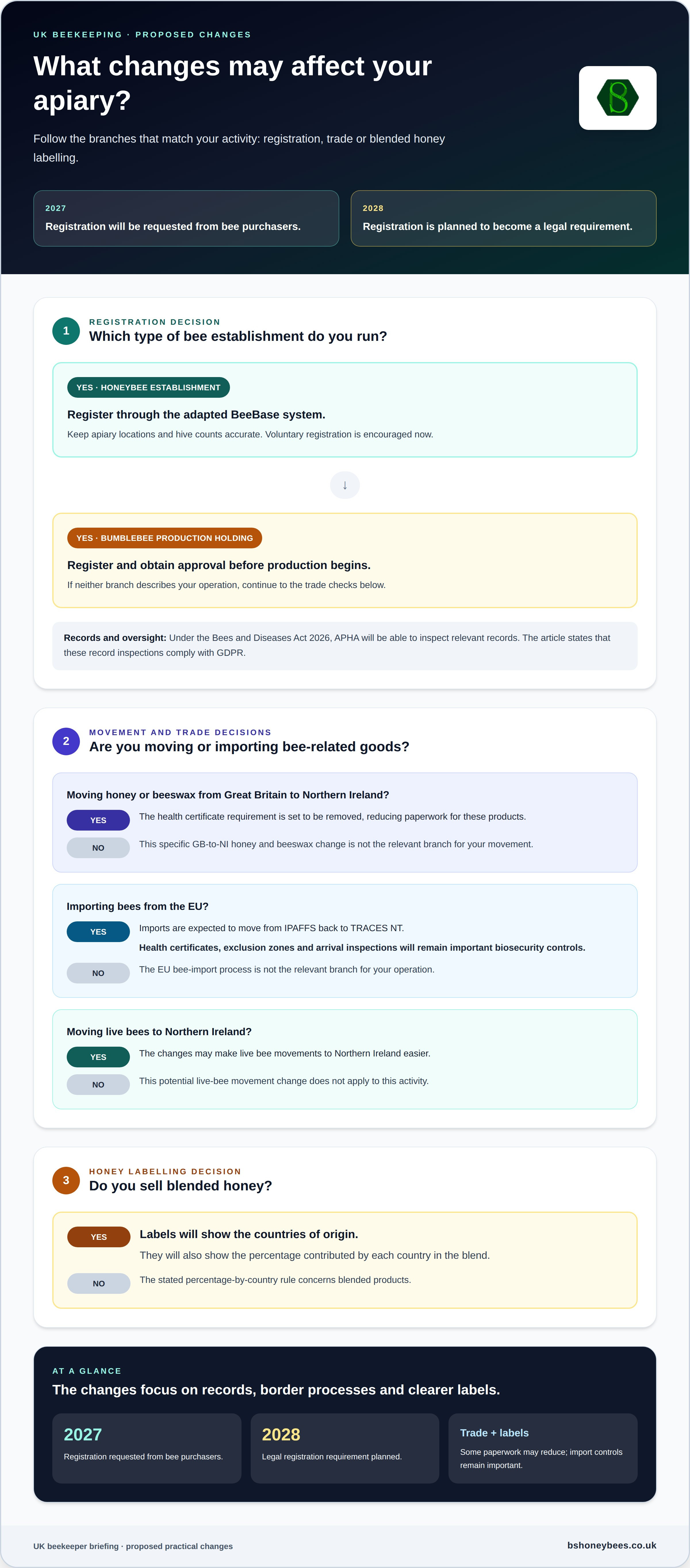
The proposed changes extend well beyond financial forecasts. Honeybee establishments will be required to register through an adapted BeeBase system, and bumblebee production holdings will need to be registered and approved before production begins. Beekeepers are encouraged to register voluntarily now and keep their apiary locations and hive counts accurate.
The planned compliance timetable gives businesses time to prepare. Registration will be requested from bee purchasers in 2027, and registration will become a legal requirement in 2028. Under the Bees and Diseases Act 2026, the Animal and Plant Health Agency (APHA) will be able to inspect the relevant records. These record inspections comply with GDPR.
For commercial and hobby beekeepers alike, this means treating registration, apiary details and colony numbers as part of normal business administration. Accurate information will support disease control and help APHA maintain a clearer picture of bee establishments across the country.
GB-NI and EU bee trade
SPS alignment should simplify some movements from Great Britain to Northern Ireland. The health certificate requirement for sending honey and beeswax from GB to NI will be removed, reducing paperwork for businesses moving these products across the Irish Sea.
There may also be an easing of live bee movements to Northern Ireland. Such movements were previously restricted under the Windsor Framework, so any change could give beekeepers and suppliers more flexibility when planning colonies, queens and nucleus movements.
For bee imports and movements from the EU, the procedure is expected to shift from IPAFFS back to TRACES NT. This aligns the process with EU SPS controls rather than treating the movements under third-country import rules. The change in system does not remove biosecurity protections: bees will still require a mandatory health certificate from the country of origin, must come from outside relevant pest and disease exclusion zones, and will undergo physical inspection by bee inspectors on arrival.
Honey labelling changes
New UK honey labelling regulations will align with EU standards for blended honey. Packaging will have to list the countries of origin in descending order, alongside the percentage contribution of each country to the blend. This will give customers clearer information about where blended honey comes from and make the origin of honey more transparent on supermarket shelves.
Political reactions to the deal
Political responses to the Brussels agreement have focused on its potential economic value and its limits. Prime Minister Andy Burnham said the deal would add £17 billion a year to the British economy. He also said the new UK-EU deals would provide a 0.5% boost to UK GDP. Those are separate estimates, not a guaranteed return for every sector or business. For beekeepers, they indicate the scale of the Government’s case for closer economic relations, rather than a specific forecast for honey production, equipment supply or individual apiaries.
Burnham also described the agreement as probably the limit of what could be achieved before the next UK national election, due by mid-2029. That frames the commitment as a substantial step, but not the end of negotiations. He envisaged an informal conversation with the European Union about further progress in about a year. The timing matters: any additional movement would depend on what both parties are willing to discuss and agree. Brussels remains central to those discussions, while the UK Government must also weigh domestic priorities.
Nigel Farage offered a different political emphasis, saying 73% of people want closer relations with Europe. That claim supports an argument for improving ties, but it does not establish that voters back every part of the summit package. A general preference for closer relations can coexist with disagreement over particular commitments, including tuition fees, youth movement or trade arrangements. For readers, the distinction is useful: political support for a broad direction does not settle how a specific measure will work, or whether future governments will seek changes.
Higher education has drawn a more cautious response. The Russell Group warned that reducing fees for EU students could put pressure on UK student places and take money out of higher education. In 2024/25, 63,600 students from the EU studied at UK higher education providers, within an overseas student total of 685,565. Before Brexit, EU students were treated as home students and could pay capped UK fees. The summit’s tuition discussions therefore touch a longstanding funding issue, not simply a new student-movement scheme.
The numbers help explain why tuition negotiations may be politically sensitive. These figures show competing pressures: restoring access or reducing fees may appeal to students and universities seeking European links, while institutions also warn about funding and places. The summit aims to conclude negotiations on a supplementary tuition-fee agreement within six months.
Reactions also reflect wider questions about cooperation. The European Commission’s proposed youth experience scheme could support movement in both directions, while discussions on defence and the economy signal broader engagement. But welcoming closer ties does not mean political parties agree on every condition or timetable. Farage’s statement, Burnham’s economic case and the Russell Group’s warning illustrate distinct priorities: public sentiment, national growth and institutional funding. None provides a direct forecast for beekeepers’ trading costs. The practical response is to follow measures affecting agricultural trade and plan business decisions around arrangements that are put into effect.
Political uncertainty can also make long-term apiary planning feel less straightforward. Decisions about equipment still rest on the needs of the operation, rather than a headline GDP estimate. If you’re planning hive capacity or replacing equipment, consider British National hives and frames as part of that practical assessment.
BS Honey Bees Ltd
BS Honey Bees Ltd helps UK beekeepers equip and stock their apiaries while wider UK-EU arrangements develop. The summit’s economic forecasts don’t determine an individual beekeeper’s needs, so practical decisions still centre on the colonies and equipment required. For expanding or replacing stock, the range includes F1 Buckfast Queens, Carniolan Queens and 5 / 6 Frame Nucs. 2 in 1 Poly Nucs offer another option for apiary planning. These products support practical beekeeping requirements; they don’t change the trade measures discussed at the summit. If you’re planning a change to your apiary, consider which stock or equipment suits your operation, then contact BS Honey Bees Ltd to discuss your requirements.
Plan your next apiary decision with confidence
The summit’s practical impact will depend on how these registration, movement, import and labelling changes are implemented. Beekeeping businesses should prepare for more accurate colony records and new registration duties, while also considering the possible benefits of simpler GB-NI trade, clearer EU movement procedures and greater transparency for honey customers.
Industry reactions are varied. Some businesses may welcome reduced paperwork and easier access to Northern Ireland, while others will focus on the additional records, approvals and inspections required. The new blended-honey labels are also likely to be welcomed by those who want consumers to see more clearly where supermarket honey comes from.
Andy Burnham’s proposals have prompted wider discussion about the future UK-EU relationship. Once you have considered the proposals and their likely effect on beekeeping, we would welcome your feedback on what these changes could mean for your business and apiaries.
BS Honey Bees Ltd offers F1 Buckfast Queens, Carniolan Queens and 5 / 6 Frame Nucs for beekeepers planning their next step. If you’re weighing up what best fits your operation, get in touch to discuss your requirements. A clear conversation can help you move from broad policy questions to a practical apiary plan.
Contact BS Honey Bees Ltd to talk through your beekeeping requirements and take your next step with confidence.
Frequently Asked Questions
What was agreed at the UK-EU Summit?
The package covered economic, energy, education and youth cooperation, alongside food-trade arrangements and fishing access. The UK and EU also agreed to work towards linking their emissions trading systems and to continue discussions on electricity-market participation. These commitments have different timelines and are not all immediate operational changes. For beekeepers, the key distinction is between the agricultural trade framework and wider agreements that may affect the economy indirectly.
What is at stake at the EU-UK summit in Brussels?
The Brussels meeting tested how far the UK and European Union could rebuild cooperation after Brexit while maintaining distinct positions. The stakes include the practical terms of food trade, future economic links, energy coordination and opportunities for young people. For beekeepers, the relevance is indirect unless arrangements affect agricultural trade or business costs. Political commitments matter most when they become workable rules that influence decisions across the supply chain.
What changes were agreed on trade, food standards and border checks?
The key food-trade commitment was an EU-UK sanitary and phytosanitary agreement, with food-price provisions due to apply from March 2028. This sets a direction for cooperation on food standards, but it should not be read as proof that every border procedure changes in the same way. Beekeepers considering trade-related impacts should distinguish the agreement’s scope from any specific inspection requirement, and avoid assuming that a broad commitment removes all checks.
How have the UK government, EU leaders and opposition parties responded?
Andy Burnham presented the deal as an economic opportunity, while Nigel Farage highlighted public support for closer European relations. The Russell Group raised concerns about the effects of lower EU student fees on university funding and places. These responses reflect different interests: economic growth, political sentiment and higher education capacity. They show why support for closer ties does not necessarily mean agreement on every term or its consequences.
When and where was the latest UK-EU summit held, and who attended?
The second UK-EU summit was held in Brussels on 20 November 2026 and was attended by leaders of the European Union and the United Kingdom.