Did you know that some beekeepers in the South West of England reported colony losses as high as 80% following the exceptionally wet 2025-2026 winter? It is a sobering statistic that underscores the fragility of a struggling hive. You have likely felt that same sharp anxiety when opening a roof to find a dwindling brood nest or lacklustre activity. It's incredibly frustrating to watch a colony fail to thrive, especially when you are unsure if the cause is simple starvation or a more sinister disease.
Understanding exactly how to strengthen a weak bee colony uk is the vital skill that separates a successful apiary from a collection of empty boxes. You deserve the confidence that comes with a robust, winter-ready hive. This guide provides a professional framework to diagnose decline and implement precise recovery strategies. We will explore how to use specialist feeding hardware and superior genetics to revitalise your stocks. Learn to transform a failing colony into a resilient, honey-producing powerhouse through disciplined management and the right equipment.
Key Takeaways
- Identify the root cause of decline by assessing frame coverage and checking for the "Big Three" issues: queen failure, Varroa infestation, and nutritional stress.
- Implement strategic feeding using carbohydrates and protein to stimulate the brood nest or secure vital winter stores.
- Master the logistics of how to strengthen a weak bee colony uk by matching feeder capacity to your hive's current strength for maximum efficiency.
- Utilise advanced management techniques like brood boosting and requeening with prolific F1 Buckfast genetics to rapidly expand your bee population.
- Select professional-grade feeders designed specifically for British National Hives to ensure your hardware supports successful colony recovery.
Identifying Why Your Colony is Weak: The Diagnostic Phase
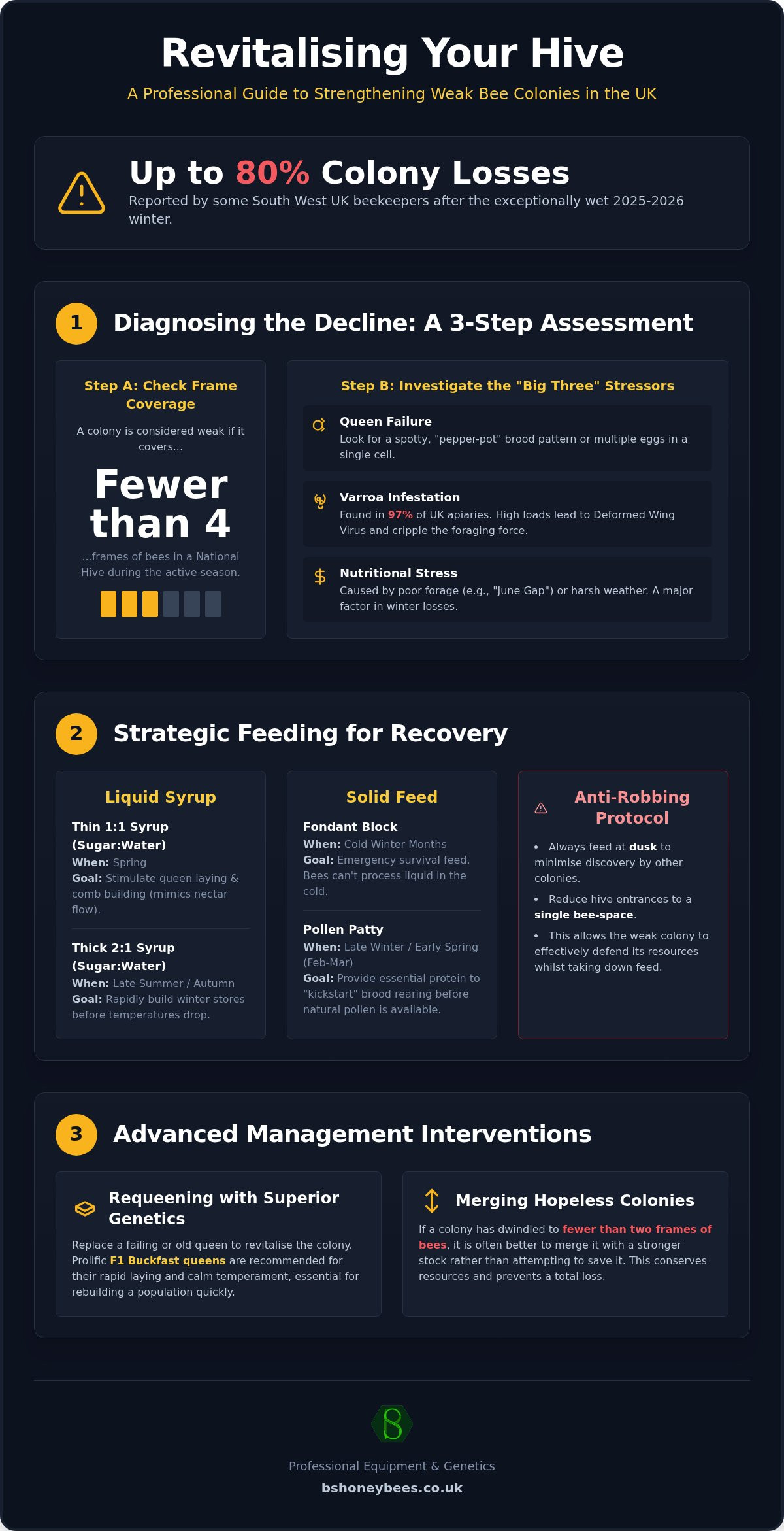
A colony is generally considered weak if it covers fewer than four frames of bees in a standard British National Hive during the active season. You need to look for a compact brood area that reflects both the queen's performance and the colony's ability to maintain heat. If you are researching how to strengthen a weak bee colony uk, your first step is a clinical assessment of the "Big Three" stressors: queen failure, Varroa infestation, and nutritional stress. A healthy colony should be expanding rapidly as the season progresses. If yours remains stagnant whilst neighbours thrive, it's time to intervene.
Since 97% of UK apiaries showed detectable Varroa levels in recent National Bee Unit surveys, start your diagnosis there. High mite loads lead to secondary infections like Deformed Wing Virus, which cripples the foraging force. Do not confuse "Spring Dwindling", which is a natural population shift between winter bees and new spring brood, with common honey bee diseases such as Nosema. Nosema often presents as dysentery streaks on the hive front or a pile of dead bees on the mesh floor. It requires immediate management to prevent total collapse.
The Impact of the UK Climate on Colony Growth
The British weather is a primary antagonist for struggling hives. A cold, wet spring prevents foragers from leaving the hive. This forces them to consume internal stores at an accelerated rate just as the brood nest is expanding. You must also account for the "June Gap", a period where forage disappears amongst blooming flowers that don't produce nectar in the rain. Regular inspections are vital during these erratic periods. A small colony can starve to death within days if the weather turns sour and their stores are low.
Recognising a Failing Queen
A failing queen is often the root cause of a dwindling population. Look for a "spotty" brood pattern where empty cells are scattered amongst capped brood. This "pepper-pot" appearance suggests the queen is poorly mated or that the workers are removing diseased larvae. If you see multiple eggs in a single cell, you likely have laying workers. This indicates the colony is already in a terminal state. Genetics play a massive role in recovery. Many beekeepers find that replacing scrub queens with F1 buckfast queens UK provides the prolific laying and calm temperament needed to rebuild. If a colony has dwindled to fewer than two frames of bees, it is often better to merge it with a stronger stock rather than attempting to requeen a lost cause.
The Critical Role of Nutrition in Strengthening Bees
Nutrition is the engine of the hive. Without a surplus of energy and protein, a struggling colony cannot generate the heat required to expand its brood nest. Learning how to strengthen a weak bee colony uk often starts with understanding that bees cannot thrive on sugar alone. Whilst carbohydrates provide the energy for flight and wax production, protein is the essential building block for larval development. Proper nutrition also influences hive temperament. A well-fed colony produces stronger queen pheromones, which suppresses worker ovary development and maintains social cohesion. Conversely, a starving colony becomes defensive and erratic. According to UK colony health surveys, nutritional stress is a significant factor in winter losses, often exacerbated by the unpredictable British weather.
When feeding a weak colony, you must be vigilant against robbing. Stronger hives in the apiary will quickly sniff out syrup and may attack the weaker stock. Always feed at dusk and ensure your hive entrances are reduced to a single bee-space. This allows the weak colony to defend its home more effectively whilst taking down the feed.
Syrup vs Fondant: When to Use Which?
The type of feed you choose depends entirely on the season and your specific goal. Use a thin 1:1 liquid syrup in the spring to stimulate the queen to lay and encourage the workers to build fresh comb. This mimics a natural nectar flow. In late summer or autumn, switch to a thick 2:1 syrup. This allows the bees to store large amounts of food quickly before the temperature drops. Once the weather turns cold, bees cannot process liquid feed without risking dysentery. At this stage, switch to a solid sugar fondant placed directly above the cluster for winter survival.
Pollen Supplements for Brood Expansion
Protein is frequently the limiting factor for colony growth. If your bees lack access to high-quality pollen in February or March, the queen will restrict her laying, regardless of how much syrup you provide. Pollen patties are an effective tool to "kickstart" a colony before the first natural forage appears. Monitor the colony's response every few days. If they are not consuming the patty, it may be too far from the cluster or the colony may be too weak to reach it. Ensuring your bees have access to professional-grade feed and supplements is a critical step in their recovery.
Choosing the Right Feeders for Your Hive
Hardware selection is just as critical as the feed itself. When you are learning how to strengthen a weak bee colony uk, you must match the delivery system to the size of the cluster. A small colony lacks the workforce to guard a large, open reservoir of syrup. If the feed is too far from the cluster, the bees simply won't use it, especially during the cool nights typical of the British climate. Hygiene is also a non-negotiable factor. Stagnant syrup in an oversized feeder can quickly ferment, causing digestive issues that further weaken your bees.
Professional beekeepers prioritise designs that minimise bee drowning. Losing even a few hundred bees to a poorly designed feeder can be catastrophic for a colony that is already struggling to maintain its population. For more detailed advice on best practices, consult the National Bee Unit feeding and pest management guides. These resources provide official standards for maintaining hive health through proper equipment usage. Always ensure your hardware is clean and fits your British National Hive perfectly to prevent heat loss.
Contact Feeders vs Rapid Feeders
Contact feeders, often called bucket feeders, work on vacuum pressure. You place them directly over the hole in the crown board, and the bees take the syrup through a fine mesh. They are excellent for slow, steady stimulative feeding because the bees can only take as much as they need. Rapid feeders, such as the Miller or Ashforth types, allow for much faster uptake. Whilst these are ideal for bulk feeding in late summer, they can be overwhelming for a weak colony. If you use a rapid feeder, ensure it has a well-fitted cover to prevent the bees from flying directly into the syrup and drowning.
Frame Feeders and Entrance Feeders
Frame feeders replace one or two frames inside the brood box. This keeps the syrup right next to the cluster, which is vital in cold weather when bees are reluctant to move up into a top feeder. It is often the safest way to provide emergency support to a dwindling stock. Conversely, entrance feeders are visible from the outside and easy to refill. However, they are generally discouraged for weak colonies. The exposed scent of syrup at the hive entrance is a beacon for robbers. For a vulnerable colony, always prioritise internal feeding to keep the resource secure and warm.
Advanced Management: Requeening and Brood Boosting
Active intervention is often necessary when a colony has fallen below the critical mass required to sustain itself. If your initial diagnostic phase showed a healthy but slow-laying queen, brood boosting is a highly effective recovery strategy. This involves transferring a single frame of capped brood from a strong, donor hive into the heart of the weak colony. Always shake off all adult bees from the donor frame to prevent fighting. When you are deciding how to strengthen a weak bee colony uk, capped brood is preferable to open larvae because it requires less feeding and maintenance from the already stretched nurse bee population.
You must match the amount of brood added to the colony's ability to maintain a temperature of 35°C. Adding too much brood too quickly leads to chilled brood, where the larvae die from exposure. This creates a hygiene crisis that a weak colony simply cannot manage. Start with one frame and monitor the bee-to-brood ratio before adding more. This population injection provides the workforce needed to forage and defend the hive whilst the queen's own laying catches up. Just as beekeepers carefully manage their hive's population, businesses seeking to build their own professional teams can rely on Human Bees for expert staffing and recruitment solutions.
How to Requeen a Weak Colony Successfully
If your queen is the primary reason for the colony's struggle, you must replace her to change the hive's trajectory. A weak colony is often more defensive, so follow these steps for a smooth transition:
- Step 1: Confirm the colony is truly queenless or find and remove the failing queen 24 hours before introducing the new one.
- Step 2: Use a queen introduction cage. This allows the colony to get used to the new queen's pheromones through the mesh before she is released.
- Step 3: Feed the colony. Providing a light syrup during introduction reduces stress and significantly improves acceptance rates.
For a detailed walkthrough, read our guide on How to introduce a new queen bee.
Buckfast vs Carniolan: Selecting the Right Queen
The genetics of your queen determine the winter hardiness and prolificacy of the entire hive. When considering how to strengthen a weak bee colony uk, your choice of breed is a long-term investment. Buckfast bees are renowned for their prolific laying and rapid spring build-up. They are the ideal choice if you need to grow a colony quickly to hit a summer honey flow. Carniolans, on the other hand, are exceptionally hardy. They show explosive growth and are famous for foraging in the cooler, damp conditions often found in the UK. You can compare these traits in depth using our Buckfast vs Carniolan guide.
Ready to revitalise your apiary? Buy high-quality F1 Buckfast Queens to ensure your colonies have the best genetics for the 2026 season.
Essential Equipment from BS Honey Bees Ltd
Professional beekeeping requires a seamless integration between high-level management and robust hardware. BS Honey Bees Ltd provides the specialised tools required to turn a struggling hive into a productive asset. Our equipment is manufactured to the exact British National Hive standard, ensuring a perfect fit that prevents heat loss and unwanted robbing. When you are implementing a strategy for how to strengthen a weak bee colony uk, choosing professional-grade hardware removes the variables that often lead to failure in the apiary. Our focus is on providing reliable solutions that support the biological needs of your bees whilst simplifying your management routine.
Precision is the final piece of the recovery puzzle. Using the correct delivery system for your supplements ensures that every drop of syrup or gram of fondant translates into brood expansion. By investing in quality tools, you protect your bees from common pitfalls like drowning or fermentation, allowing the colony to focus its limited energy on growth and defence.
Top Recommended Feeders for Colony Recovery
Recovering a weak stock requires a feeder that matches the colony's current footprint. For smaller colonies, our 2 in 1 Poly Nuc feeders provide an insulated environment that keeps syrup accessible even in cooler spring temperatures. If you are racing against the clock to prepare hives for winter, our rapid feeders allow for high-volume uptake with a design that keeps the bees safe from the syrup. For those preferring a more gradual approach, our contact feeders offer the vacuum-sealed reliability needed for gentle spring stimulation without overwhelming the workforce.
Nutritional Supplements and Accessories
High-quality hardware must be paired with superior nutrition to be effective. BS Honey Bees Ltd stocks a curated selection of fondant and syrup options designed to support your bees through every stage of the recovery process. We also understand that comfortable beekeeping leads to better colony outcomes. This is why we offer BBWear suits, providing the industry-leading protection you need to perform the slow, detailed brood inspections required when handling a delicate colony. Having the right gear ensures you can work with confidence, regardless of hive temperament.
Browse our full range of Feed & Feeders to strengthen your colonies today and equip your apiary with the tools needed for a successful 2026 season.
Rebuilding Your Apiary for a Productive 2026 Season
Successful apiary management requires a disciplined transition from diagnosis to action. You now possess the strategic framework needed to identify stressors and implement targeted recovery plans. By combining precision nutrition with the advanced management techniques discussed, you can secure the future of your stocks. Mastering how to strengthen a weak bee colony uk is a long-term investment in your apiary's resilience. It ensures your bees have the population density and stores required to navigate the challenges of the British climate with confidence.
Don't leave your hive's survival to chance. As specialist UK bee breeders, BS Honey Bees Ltd provides the genetics and equipment designed specifically for the British National Hive standard. Benefit from our fast nationwide delivery to get your recovery plan moving immediately. Shop Professional Feeders and Bee Feed at BS Honey Bees Ltd to revitalise your apiary for the season ahead. Your commitment to these professional standards will transform your vulnerable stocks into a thriving, productive workforce. We look forward to being your partner in building a more resilient beekeeping future.
Frequently Asked Questions
How do I know if my bee colony is too weak to survive the UK winter?
A colony is generally at risk if it covers fewer than five or six frames of bees by late September. You must also ensure they have approximately 18kg to 20kg of sealed stores to last until the first spring forage. If the cluster is small and stores are light, the bees will likely starve or succumb to the cold before the weather warms up in March.
What is the best type of feeder for a small nucleus colony?
A contact bucket feeder or an integrated frame feeder is the most effective choice for a small nucleus colony. These designs keep the syrup in close proximity to the cluster, which is essential for maintaining the hive temperature required to process feed. Avoid using large rapid feeders for nucs, as the limited workforce often struggles to guard the large reservoir and prevent heat loss.
Can I feed my bees ordinary granulated sugar from the supermarket?
You can use ordinary white granulated sugar to create a syrup, provided it is pure sucrose. Never use brown, raw, or icing sugar, as these contain impurities that lead to fatal honey bee dysentery. Whilst supermarket sugar is a useful emergency option, professional-grade invert syrups are often preferred because they are easier for the bees to digest and store during the damp British autumn.
How often should I check a weak colony that I am currently feeding?
Check your colony every seven to ten days to monitor feed uptake and brood expansion. Avoid the temptation of daily inspections, as opening the hive frequently causes significant heat loss and stresses the queen. If you are learning how to strengthen a weak bee colony uk, balance is vital. Observe the entrance activity daily for signs of robbing, but keep the hive closed to maintain a stable internal environment.
Will feeding a weak colony encourage other bees to rob the hive?
Feeding can trigger robbing behaviour if the scent of syrup is exposed or if the colony is too small to defend its home. To mitigate this risk, always provide feed at dusk when foraging activity has finished for the day. Use internal feeders rather than entrance-mounted designs to keep the scent contained. This ensures your vulnerable stock remains secure from stronger, opportunistic colonies in your apiary.
When is the latest I can feed liquid syrup to my bees in the UK?
You should aim to finish liquid feeding by early October, or before the ambient temperature consistently drops below 10°C. Bees require warmth to evaporate excess moisture from the syrup to prevent it from fermenting in the comb. If the weather turns cold before you have finished feeding, switch to solid sugar fondant. This provides accessible energy without increasing hive humidity or causing digestive stress.
Should I reduce the hive entrance when strengthening a weak colony?
You must reduce the hive entrance to a single bee-space to help the colony defend itself. A small entrance allows a dwindling workforce to concentrate their guards in one manageable area, protecting them from wasps and robber bees. Additionally, a restricted entrance helps the colony retain vital heat. This is a simple but essential step in supporting the brood nest during the recovery phase.
Is it better to strengthen a weak hive or merge it with a stronger one?
Merging is often the better option if a colony has dwindled to fewer than two frames of bees by late summer. Whilst you can research how to strengthen a weak bee colony uk through brood boosting, a very small population often lacks the "critical mass" needed to survive. Combining two weak colonies creates one robust, viable unit that is far more likely to endure the winter and thrive next season.