A failing queen is not just a minor setback; it is a ticking clock for the survival of your entire hive. You might notice a slight dip in activity and hope it's a seasonal phase, but ignoring the early signs of a failing queen bee often leads to a colony collapse that could have been prevented. It is a frustrating position to be in, especially when you are trying to distinguish between natural hygienic behaviour and a genuine genetic decline.
We understand the pressure of making the right call for your apiary. This guide provides the professional clarity you need to stop second-guessing your inspections. We will move beyond the guesswork, offering a definitive "act now" versus "wait" framework that builds your confidence in identifying pheromone issues before they become fatal. You'll learn exactly how to assess queen performance and the precise steps to take when it's time to organise a replacement. We will cover ten critical indicators of failure and the best methods to requeen successfully with superior genetics, ensuring your colony remains a productive and healthy asset throughout 2026.
Key Takeaways
- Learn how the queen acts as the colony's pheromone 'glue' and why her ability to produce viable worker brood is the ultimate measure of hive health.
- Master the visual difference between a high-performance 'wall-to-wall' brood pattern and the warning signs of a 'pepper-box' or spotty layout.
- Identify the specific behavioural red flags and acoustic changes, such as the 'queenless roar', that serve as definitive signs of a failing queen bee.
- Understand how to distinguish a genuine queen failure from natural UK seasonal lulls, including the mid-summer 'June Gap' or autumn wind-down.
- Gain a clear framework for deciding when to intervene and why introducing a mated queen is often superior to letting the colony requeen themselves.
Understanding the Queen’s Role in Colony Vitality
The queen is the biological heart of your hive. She provides the genetic blueprint for every worker and drone, whilst her pheromones act as the chemical "glue" that keeps the colony organised and focused. Queen failure is specifically defined as her inability to produce sufficient viable worker brood to sustain the colony's population. When this production drops below the mortality rate of the workers, the hive enters a terminal decline. It is a logistical crisis that requires immediate intervention to prevent the loss of the entire colony.
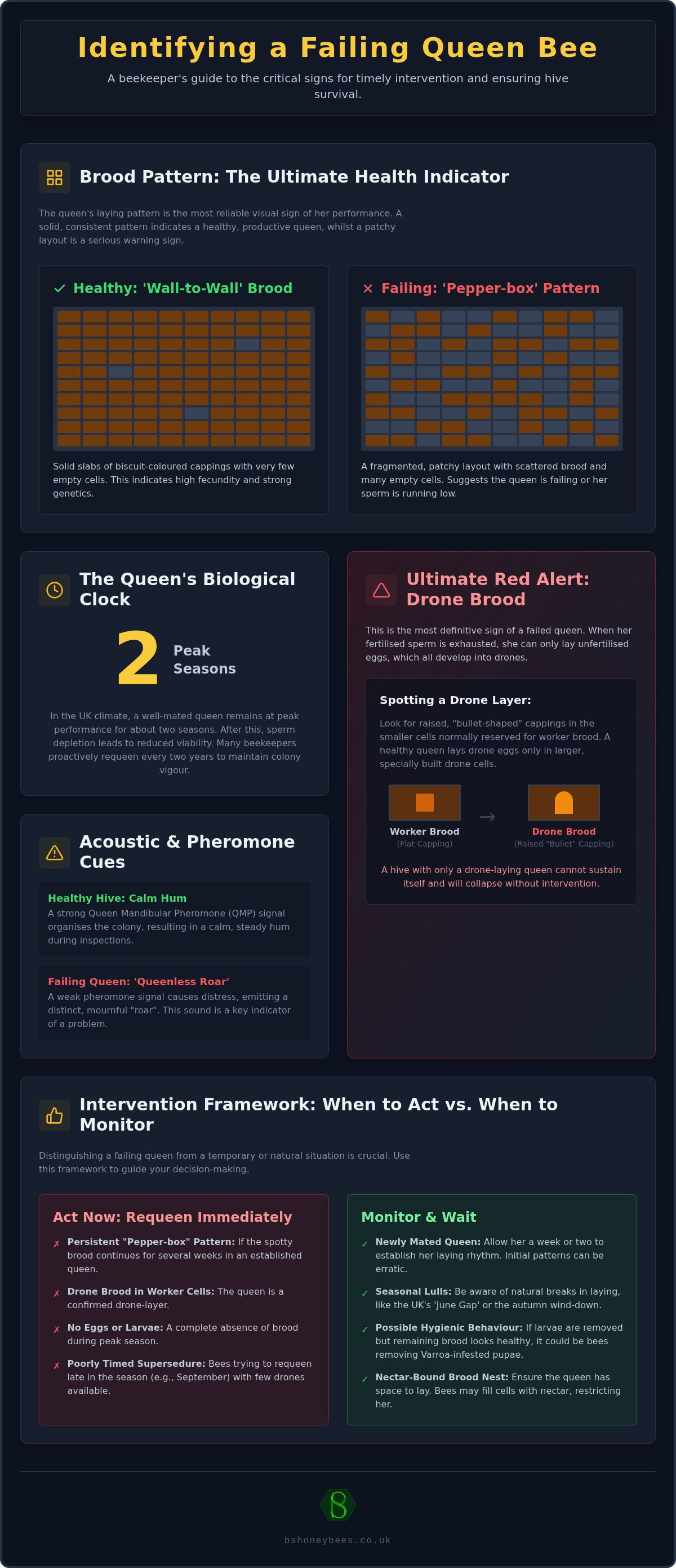
Don't panic if a newly mated queen looks a bit erratic in her first week of laying. These "teething problems" often resolve once she finds her rhythm and the workers polish the cells correctly. However, a persistent "pepper-box" pattern in an established queen is one of the most reliable signs of a failing queen bee. The bees will often attempt supersedure, their natural process of replacing a failing mother, but this is frequently poorly timed. A colony might try to requeen in late September when drone availability is low, leading to a poorly mated successor that won't survive the winter. Recognising the difference between a natural transition and a biological failure is key to your success.
The Biological Shelf-Life of a Honey Bee Queen
A queen’s productivity is dictated by her sperm store, which she collects during her initial mating flights. In the UK climate, a well-mated queen typically remains at peak performance for about two seasons. As she ages, sperm depletion leads to more unfertilised eggs being laid in worker cells, resulting in a drone-heavy brood nest. Many proactive beekeepers choose to requeen every two years. This ensures the colony maintains the vigour required to forage effectively and survive the damp British winters.
Pheromones: The Invisible Signal of a Healthy Queen
Queen Mandibular Pheromone (QMP) is the primary signal that tells the workers their leader is present and productive. It suppresses the development of worker ovaries and maintains social order. When these pheromones weaken, the bees start building emergency queen cells. You can often hear the change before you see it. A colony with a failing queen or one that is recently queenless emits a distinct, mournful "roar" during inspections. This is a sharp contrast to the calm, steady hum of a healthy hive. Listen closely to your bees; they often tell you about signs of a failing queen bee before the brood nest reveals the full extent of the problem.
Analysing Brood Patterns: The 'Spotty' Warning Sign
A high-performance F1 Buckfast queen is a marvel of biological efficiency. When she is at her peak, you should see "wall-to-wall" brood; solid slabs of pearly white larvae or biscuit-coloured cappings with almost no empty cells. This uniformity is the hallmark of a queen with high fecundity and strong genetics. If your inspections reveal a fragmented "pepper-box" pattern instead, you are likely witnessing one of the most reliable signs of a failing queen bee. This inconsistency suggests she is either running out of viable sperm or her egg-laying pace has slowed to the point where the colony's replacement rate is in jeopardy.
It is vital to distinguish between a failing queen and high hygienic behaviour. In some instances, workers will remove larvae that are diseased or infested with Varroa mites, creating a "spotty" appearance. To tell the difference, look at the health of the remaining larvae. If they appear slumped, discoloured, or melted, the issue is likely pathological. However, if the larvae look healthy but are simply scattered at different ages across the frame, the queen’s laying rhythm is the problem. A productive queen should lay in tight, concentric circles, moving outward from the centre of the frame.
The Shotgun Pattern: Empty Cells and Gaps
A "shotgun" pattern occurs when a queen leaves significant gaps between capped cells. This often happens because she is laying eggs that fail to hatch or because her pheromone signal is too weak to coordinate the workers' cell-polishing duties. Check for mismatched ages; if you see a day-old larva sitting immediately next to a nearly-mature capped cell, the queen’s laying is erratic. Before you condemn her, ensure the bees haven't simply "chimneyed" the brood nest by filling every available cell with nectar, which leaves her with nowhere to lay.
Drone Brood in Worker Cells
This is the ultimate red alert for any beekeeper. If you notice raised, "bullet-shaped" cappings in the smaller cells typically reserved for workers, you have a drone-layer. This happens when a queen has exhausted her store of fertilised sperm. She continues to lay, but every egg develops into a drone. Since drones do not forage or clean the hive, a drone-laying queen represents a terminal condition for the colony. Without swift intervention, the worker population will age out and the hive will perish.
Identifying these patterns early allows you to take control before the colony's temperament sours or the population collapses. If your current queen is showing these symptoms, it is often more efficient to upgrade to proven F1 Buckfast genetics than to hope for a late-season recovery. Proactive replacement is the only way to ensure your bees are strong enough to face the winter months ahead.
Behavioural Red Flags: Pheromones and Temperament
A colony's temperament is often a direct reflection of its queen's pheromone strength. When her chemical signals begin to fade, the social order of the hive disintegrates. You might notice the bees seem "runny" on the comb, scurrying aimlessly across the frames rather than attending to brood or stores with their usual purpose. This lack of focus extends to their collective work ethic; cleaning and foraging become uncoordinated and inefficient. These behavioural shifts are subtle but definitive signs of a failing queen bee that experienced keepers never ignore.
During inspections, pay close attention to the sound of the hive. A healthy colony has a low, industrious hum that signals stability. A failing or queenless colony emits a higher-pitched, mournful "roar" that persists long after the crown board is removed. This acoustic change, combined with increased defensiveness and "followers" who pursue you across the apiary after you've closed the hive, signals that the workers feel vulnerable. They are no longer protected by the calming influence of a strong queen. When workers start "pinging" your veil or showing uncharacteristic aggression, they are communicating a lack of pheromonal stability.
Colony Temperament and Queen Acceptance
A drop in pheromone levels triggers a defensive instinct in worker bees. Without the queen's chemical reassurance, the colony becomes hyper-sensitive to disturbances and environmental stressors. Genetic factors play a massive role here, which is why gentle honey bee breeds UK beekeepers prefer, such as Buckfast, are so valuable for maintaining apiary harmony. They maintain a calm disposition even during difficult transitions. If a normally docile colony suddenly turns aggressive, don't blame the weather; check the queen's performance first.
The Presence of Multiple Queen Cells
The bees are often the first to diagnose a biological problem. If you find queen cells on the face of the comb, these are likely supersedure cells. The workers have identified signs of a failing queen bee and are attempting an emergency replacement. Contrast this with swarm cells, which are typically found hanging from the bottom of the frames. You might also see "play cups", which are empty, acorn-shaped starters. Whilst these are common, a "charged" cell containing a larva and royal jelly is a definitive call to action. Never simply knock down supersedure cells. Doing so leaves the colony with a failing queen and no successor, which is a recipe for a late-season collapse. Assess the situation and decide if you should let them continue or intervene with a high-quality mated queen.
Differentiating Failing Queens from Seasonal Shifts
Beekeepers often panic when they see a reduction in brood, but context is everything in a UK apiary. Not every dip in laying is amongst the signs of a failing queen bee. In Britain, our weather is a primary driver of colony activity. During a nectar dearth, such as the notorious "June Gap", a perfectly healthy queen will significantly reduce her egg-laying to conserve resources. If there is no nectar coming in and the honey stores are low, the workers will even cannibalise young larvae to protect the colony's survival. Before you condemn a queen, check the frames for liquid stores and pollen. If the larder is empty, she isn't failing; she is simply waiting for better foraging conditions.
Misdiagnosing a healthy queen during a seasonal lull is a common mistake that can lead to unnecessary requeening. A queen requires a consistent flow of protein and carbohydrates to maintain a high laying rate. If your inspection reveals a lack of fresh nectar or "dry" honey arcs above the brood nest, try feeding a light syrup. If she resumes a solid laying pattern within a week, her biological engine is still sound. Diagnosis must always begin with an assessment of the environment and the hive's internal stores.
Spring Build-Up vs. Autumn Decline
Expectations must shift with the seasons. In April and May, a high-quality queen should be expanding the brood nest rapidly, often achieving that "wall-to-wall" ideal. However, as we move into September, a natural contraction occurs. The queen slows down to focus on producing long-lived "winter bees" rather than a massive foraging force. At this stage, she will lay in a tighter, more compact area in the centre of the cluster. This is a strategic retreat, not a sign of exhaustion. Only worry if the autumn brood is scattered or contains excessive drone cells.
The Impact of Varroa and Disease
Parasitic Mite Syndrome (PMS) is the great imitator of queen failure. High Varroa loads cause workers to remove infested larvae, resulting in a spotty brood pattern that looks identical to a failing queen's output. Look for other symptoms of colony stress, such as bees with Deformed Wing Virus (DWV) or larvae slumped in their cells. You must treat for Varroa and ensure the colony is healthy before you can accurately judge the queen's performance. A queen struggling in a mite-infested hive might thrive once the parasitic pressure is removed.
If you have ruled out starvation, seasonal shifts, and disease, and the brood pattern remains poor, then you are dealing with a genuine biological decline. In these cases, proactive intervention is the only way to save the hive. If your diagnosis confirms a failure, you can order a high-quality mated queen to restore your colony's strength and ensure they are prepared for the winter months.
Strategic Requeening: Restoring Colony Productivity
Once you've confirmed the signs of a failing queen bee, the window for effective action is often shorter than you think. You face a critical choice: let the bees attempt a natural supersedure or intervene with a new queen. Whilst the bees' instincts are strong, natural requeening is a gamble that takes three to four weeks to complete. In the unpredictable British climate, this gap in brood production can be the difference between a thriving hive and a winter loss. Choosing to introduce a mated queen bee provides an immediate restart, bypasses the mating risks, and ensures the colony has enough time to produce the essential "fat" bees required for winter survival.
How to Introduce a New Queen Successfully
Success depends on ensuring the colony is truly queenless before you begin. Even a failing queen or a virgin queen will cause the workers to reject a newcomer. Remove the old queen at least 24 hours prior to introduction. Whilst a standard mailing cage with a candy plug is effective, many professionals prefer a "push-in" cage for valuable F1 queens. This allows the queen to begin laying in a small area of comb immediately, which increases the workers' acceptance rate. For a detailed walkthrough, follow our guide on how to introduce a new queen bee to ensure a seamless transition.
Choosing Your Replacement: Buckfast vs. Carniolan
Your choice of breed should align with your management style and local forage. F1 Buckfast queens are the industry standard for prolific laying and massive honey crops; they are designed for the modern beekeeper who wants a hardworking, gentle colony. Carniolan queens, by contrast, are famous for their explosive spring build-up and their ability to shut down quickly in autumn to conserve stores. Both breeds offer excellent overwintering capabilities in the UK. Sourcing from a specialist UK breeder ensures your queens are adapted to our specific standards and arrive in peak condition, ready to transform a failing hive into a productive asset.
Secure the Future of Your Apiary
Managing a successful colony requires more than just passive observation; it demands a proactive approach to queen health. By mastering the visual cues of brood patterns and the subtle shifts in hive temperament, you can intervene before a decline becomes a collapse. Identifying the early signs of a failing queen bee allows you to move from uncertainty to action, ensuring your bees have the leadership they need to thrive. Remember to always rule out seasonal gaps and Varroa pressure before making the final decision to requeen.
When the time comes to refresh your genetics, don't leave your hive's survival to chance. We are specialist F1 Buckfast and Carniolan breeders, providing high-performance genetics specifically selected for UK climates. With our safe nationwide delivery of mated queens, you can restore your colony's vigour with confidence. Upgrade your colony with an F1 Buckfast Queen – Order for 2026 delivery and give your apiary the best possible start for the season ahead. Your bees are a valuable asset; protect them with the standards they deserve.
Frequently Asked Questions
What does a spotty brood pattern actually look like?
A spotty brood pattern, often called a "pepper-box" layout, looks like a fragmented mosaic rather than a solid, uniform sheet of cappings. Instead of concentric rings of larvae at similar ages, you will see significant gaps and empty cells interspersed with capped brood. Whilst this can sometimes indicate hygienic behaviour, a persistent lack of uniformity across multiple frames is amongst the primary signs of a failing queen bee.
Can a failing queen bee recover her laying ability?
Biological failure, such as sperm depletion or old age, is irreversible. A queen cannot "rest" and regain her fertility once her biological stores are exhausted. However, if her poor performance is caused by temporary environmental factors like a nectar dearth or starvation, she may resume normal laying once the colony is fed. If she doesn't respond to feeding within a week, she must be replaced to save the hive.
How do I know if my queen is a drone layer?
You can identify a drone-laying queen by looking for raised, "bullet-shaped" cappings in the smaller cells typically reserved for workers. Because drones are larger than workers, the bees are forced to extend the cell cappings outward, creating a bumpy, uneven surface. If you see these domed cappings consistently in the worker brood area, it confirms the queen has run out of fertilised sperm and is no longer viable.
Is it better to let the bees requeen themselves (supersedure)?
Whilst supersedure is a natural process, it is often a logistical gamble for UK beekeepers. A colony takes nearly a month to produce and mate a new queen, during which time the brood cycle is broken. If the weather is poor during the mating flight, the new queen may be poorly mated or lost entirely. Introducing a proven, mated queen is a much more reliable way to ensure colony survival.
When is it too late in the season to requeen a hive in the UK?
The practical limit for requeening in the UK is usually early September. You need the new queen to be settled and laying by mid-September to ensure she produces a sufficient population of "winter bees". These long-lived workers are essential for the colony to survive the cold, damp months. Requeening any later increases the risk of the queen not being accepted or failing to build up enough strength before winter.
Why are my bees suddenly aggressive and 'flighty'?
Sudden aggression and "runny" behaviour on the comb are common signs of a failing queen bee. When queen mandibular pheromone levels drop, the social order of the hive collapses and the workers become hyper-sensitive to disturbances. This defensive response is the bees' way of protecting a vulnerable colony that lacks the stabilising influence of a high-performance queen. If your normally gentle bees start "pinging" your veil, check the queen's performance.
How long should I wait after introducing a new queen to check for eggs?
Wait at least seven to ten days before performing a full inspection to check for eggs. Opening the hive too early can cause the workers to "ball" and kill the new queen due to stress. You can check the cage after three days to ensure she has been released, but avoid disturbing the brood nest until she has had time to establish her pheromone signature and start her laying rhythm.
What is the 'queenless roar' and how can I identify it?
The "queenless roar" is a distinct, high-pitched buzzing sound that occurs when a colony lacks a queen or her pheromones are significantly depleted. Unlike the steady, industrious hum of a healthy hive, this roar is mournful and persists long after you open the hive. It's often accompanied by bees fanning their wings with their abdomens raised, desperately trying to find a pheromone signal that no longer exists in the hive.